Protein Shake Vending Machine Profit Margin: 70% Possible?
Can a protein vending machine really generate a 70% gross margin? The answer might surprise you.
A protein shake vending machine profit margin depends on more than the selling price of whey protein. While protein shakes attract fitness enthusiasts, beverages such as black coffee, creatine drinks, and other powdered premixes can create additional opportunities for better margins.
For gym owners and vending investors, the real opportunity isn't necessarily earning 70% on every drink. Instead, it's building a profitable beverage menu that combines customer demand, smart pricing, and automated preparation.
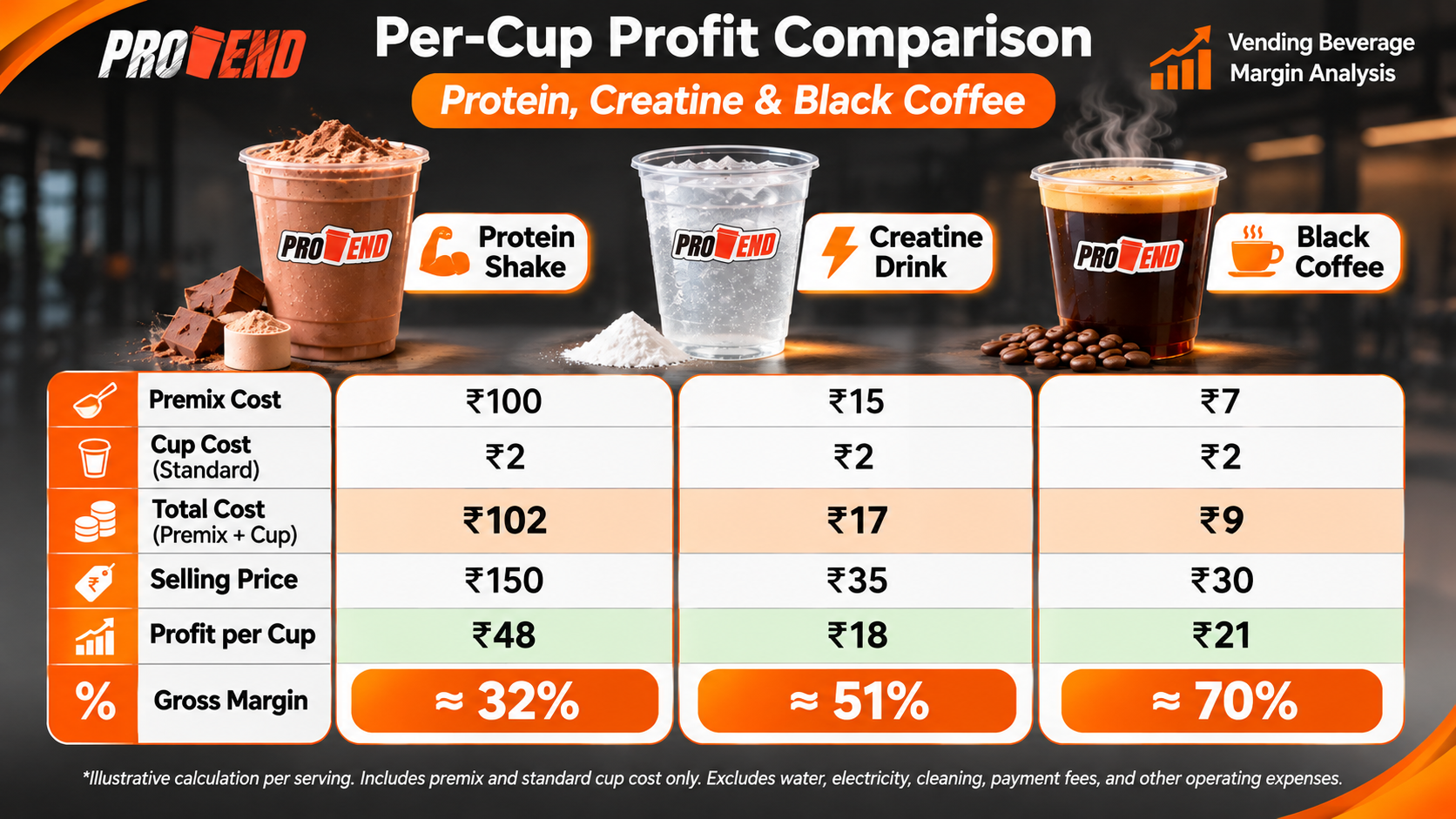
ProVend beverage vending margin comparison: protein shakes (~32%), creatine drinks (~51%), and black coffee (~70%), based on illustrative ingredient and cup costs before other operating expenses.Image details
Hero infographic for ProVend's guide to protein shake vending machine profit margins. Featuring the original black ProVend smart beverage vending machine and transparent ProVend-branded cups, the visual compares illustrative per-serving margins for protein shakes (32%), creatine drinks (51%), and black coffee (70%). Calculations include premix and standard cup costs but exclude other operating expenses. Designed for gym owners, fitness facility operators, and vending investors.
Quick Answer: Can a Protein Vending Machine Earn a 70% Gross Margin?
Yes, certain drinks can achieve a 70% gross margin before all operating expenses.
For example, a black coffee sold for ₹30, containing ₹7 worth of premix and served in a ₹2 cup, provides ₹21 in contribution per serving. That's a 70% margin before other costs.
However, a protein shake sold for ₹150 with ₹100 of premix and a ₹2 cup delivers a 32% margin on the same basis.
Therefore, the most effective strategy is to offer multiple beverages with different price points and margins rather than depending entirely on protein shakes.
Protein Shake Vending Machine Profit Margin: The Real Numbers
Many entrepreneurs evaluate a vending business by looking only at revenue. However, understanding the cost of every drink is essential before calculating profitability.
Let's consider an illustrative ProVend operating scenario using realistic ingredient and cup prices.
Beverage
Premix Cost
Selling Price
Cost Including ₹2 Cup
Contribution per Cup
Margin
Protein Shake
₹100
₹150
₹102
₹48
32.0%
Creatine Drink
₹15
₹35
₹17
₹18
51.4%
Black Coffee
₹7
₹30
₹9
₹21
70.0%
Premium Black Coffee
₹7
₹40
₹9
₹31
77.5%
These calculations include premix and standard cup costs only. They exclude water, electricity, cleaning, payment processing, wastage, location commissions, taxes, and other operating expenses. Actual product costs and margins vary.
The numbers reveal an important opportunity.
Although protein shakes generate more contribution per cup in rupee terms, black coffee offers a higher percentage margin under these assumptions.
Similarly, creatine drinks can provide another profitable menu option when sold at an appropriate price.
The takeaway? A profitable vending machine needs the right combination of beverages, not just one high-selling product.
Per-cup margin comparison: protein shakes (32%), creatine drinks (51.4%), and black coffee (70%). Calculations include premix and a ₹2 standard cup, excluding other operating costs.Image details
ProVend beverage vending profitability infographic comparing the illustrative per-serving economics of three popular fitness drinks. A protein shake costs ₹102 in premix and cup expenses and sells for ₹150, generating ₹48 contribution and a 32% margin. A creatine drink costs ₹17 and sells for ₹35, generating ₹18 contribution and a 51.4% margin. Black coffee costs ₹9 and sells for ₹30, generating ₹21 contribution and a 70% margin. The graphic features transparent ProVend-branded cups and the company's orange-and-black visual identity. Figures exclude water, electricity, cleaning, payment processing, taxes, and additional operating expenses.
Fresh-Mixed Protein Shakes vs Ready-to-Drink Bottles
Traditional ready-to-drink (RTD) protein beverages are convenient. However, their pricing structure differs from freshly prepared drinks.
With RTD bottles, retailers purchase a finished product that already includes manufacturing, packaging, and distribution costs.
In contrast, fresh-mixed vending machines use powdered ingredients and water to prepare beverages when customers place an order.
Why Fresh-Mixed Vending Can Be More Flexible
Fresh-mixed beverage systems offer several advantages:
Operators can source compatible powdered premixes.
Different drinks can be offered through one machine.
Beverage recipes can be configured in advance.
Customers receive drinks prepared on demand.
Operators can update their menus without stocking numerous bottled flavors.
Furthermore, powdered ingredients can simplify certain inventory requirements, depending on their shelf life and storage conditions.
However, fresh-mixed vending also requires regular cleaning, dependable water quality, and accurate dispensing.
Is Fresh-Mixed Protein Always More Profitable?
Not necessarily.
For example, if a fresh protein shake costs ₹102 in powder and cup expenses, it must compete against the actual wholesale purchase price of an equivalent RTD bottle.
Without verified RTD wholesale prices, claiming that fresh-mixed protein always provides higher margins would be misleading.
Instead, investors should compare products with similar protein content, serving sizes, nutritional quality, and retail prices.
Fresh-mixed vending offers an opportunity for improved economics, but the advantage must be calculated for each product.
Why Black Coffee Could Be a High-Margin Vending Product
Black coffee is one of the most interesting additions to a fitness beverage menu because its ingredient cost can be relatively low.
Consider the following example:
Coffee premix: ₹7
Standard cup: ₹2
Selling price: ₹30
Contribution per drink: ₹21
Margin before other expenses: 70%
If the same drink sells for ₹40, the contribution increases to ₹31, producing a 77.5% margin on the same basis.
Consequently, coffee can become an attractive product for gyms looking to offer more than post-workout protein.
Why Coffee Works in Fitness Facilities
Coffee may appeal to members arriving before their morning workout, professionals visiting the gym after work, or customers who simply enjoy a hot beverage.
Additionally, offering both hot and cold coffee options can make the beverage station useful throughout the year.
However, operators should configure appropriate serving sizes and clearly communicate caffeine content where applicable.
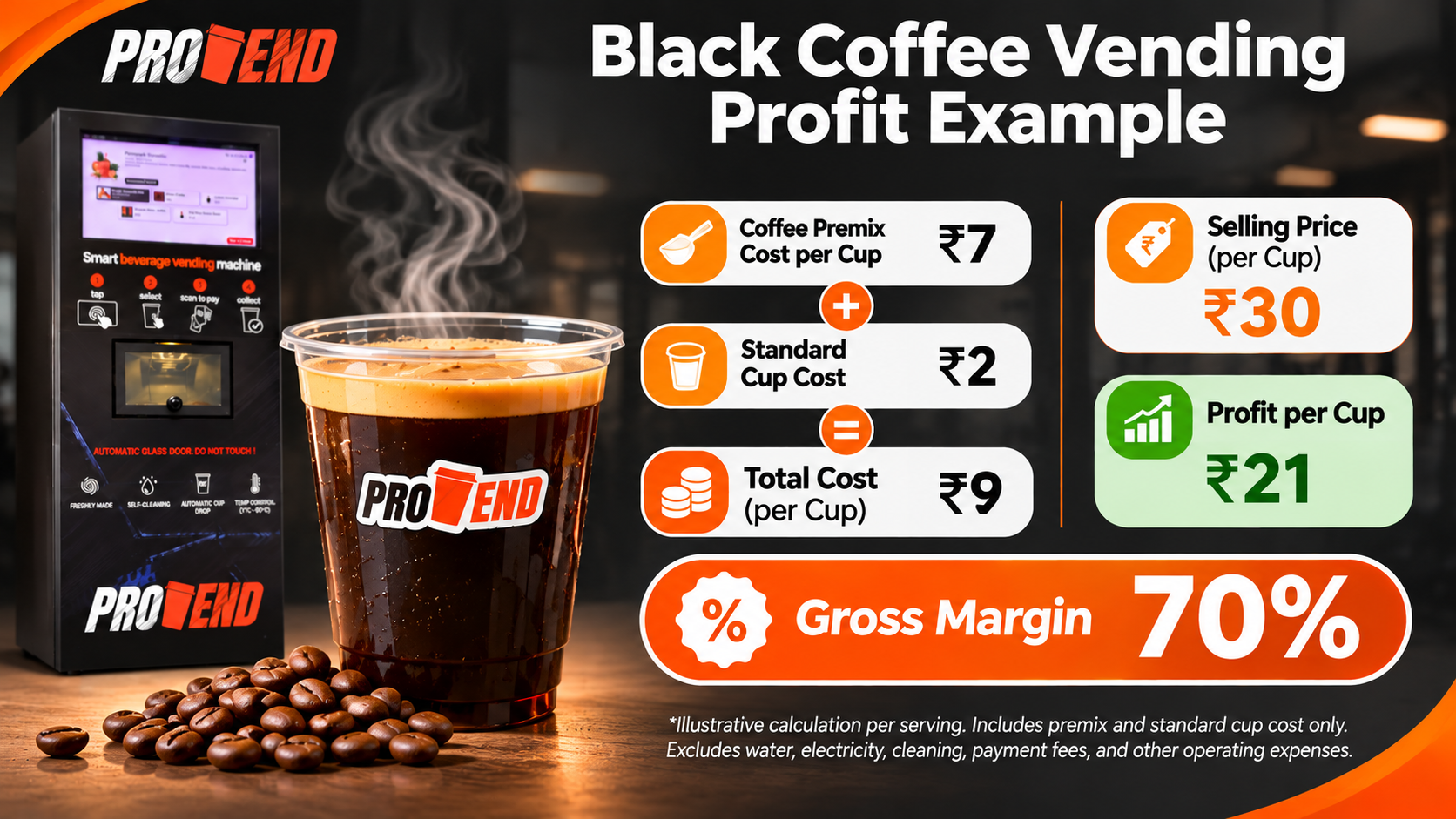
Black coffee vending profitability: ₹9 combined premix and cup cost, ₹30 selling price and ₹21 contribution per serving—equivalent to a 70% margin before other operating expenses.Image details
ProVend black coffee vending machine profitability infographic featuring the original black ProVend smart beverage vending machine and a transparent ProVend-branded coffee cup. The visual illustrates the per-serving economics of automated black coffee vending: ₹7 coffee premix, ₹2 standard cup, ₹9 combined cost, ₹30 selling price and ₹21 contribution per cup, representing a 70% margin on the stated costs. This illustrative example excludes water, electricity, cleaning, payment processing, machine maintenance, taxes and other operating expenses. Created for ProVend's guide to protein shake vending machine profit margins and multi-beverage vending profitability.
Creatine Drinks: Another Opportunity Beyond Protein
Creatine is widely used in sports nutrition, particularly among people involved in strength training and high-intensity exercise.
Unlike caffeine, creatine should not be promoted as an instant energy stimulant.
Nevertheless, it can be offered as a convenient, correctly portioned supplement drink.
Creatine Vending Machine Profit Example
Consider a creatine serving with these costs:
Item
Amount
Creatine ingredient cost
₹15
Standard cup
₹2
Total known direct cost
₹17
Selling price
₹35
Contribution per drink
₹18
Margin before other expenses
51.4%
This makes creatine a potential complementary product alongside protein shakes and coffee.
However, formulation compatibility is essential. Creatine monohydrate does not fully dissolve like sugar, so operators must validate dispersion, dosing accuracy, and serving consistency before configuring it in a machine.
Why a Multi-Beverage Menu Can Increase Overall Profitability
One of the biggest mistakes vending investors make is evaluating their business around a single product.
Protein shakes may attract the target audience, but they don't have to represent every sale.
A better strategy is to offer a balanced menu.
For example:
Beverage Category
Business Role
Protein Shakes
Core fitness product with higher contribution per cup
Creatine Drinks
Supplement-focused menu option
Black Coffee
Potential high-percentage-margin beverage
Electrolyte Drinks
Hydration-focused beverage
Coconut Water Premix
Refreshment option, subject to recipe compatibility
Other Compatible Premixes
Seasonal or location-specific menu variety
This approach gives customers more reasons to use the machine.
Moreover, it helps operators adapt their offerings to different audiences and spending preferences.
Can Coconut Water Be Served Through a Vending Machine?
Yes, provided a suitable powdered coconut-water formulation is compatible with the dispensing and mixing system.
The operator should verify the premix's solubility, storage requirements, taste, and nutritional specifications.
The same principle applies to other beverage powders.
Therefore, the machine's value comes not only from protein sales but also from its ability to support a varied beverage menu.
Example: Monthly Revenue from a Mixed Beverage Menu
Let's consider an illustrative machine selling 50 drinks daily.
Assume the following daily sales:
Beverage
Cups/Day
Price
Daily Revenue
Protein Shake
20
₹150
₹3,000
Creatine Drink
15
₹35
₹525
Black Coffee
15
₹35
₹525
Total
50
₹4,050
Over 30 days, that produces:
Monthly Revenue: ₹1,21,500
Using the earlier ingredient costs and a ₹2 cup:
Protein contribution: ₹960/day
Creatine contribution: ₹270/day
Coffee contribution: ₹390/day
Total Daily Contribution: ₹1,620
Monthly Contribution: ₹48,600
Combined Margin: 40%
This example shows how a diversified beverage menu can generate revenue from several products rather than relying entirely on protein.
However, ₹48,600 is not net monthly profit. Machine ownership costs, location charges, maintenance, payment fees, cleaning and other expenses still need to be deducted.
Actual sales may also vary with location, customer demand, and operating days.
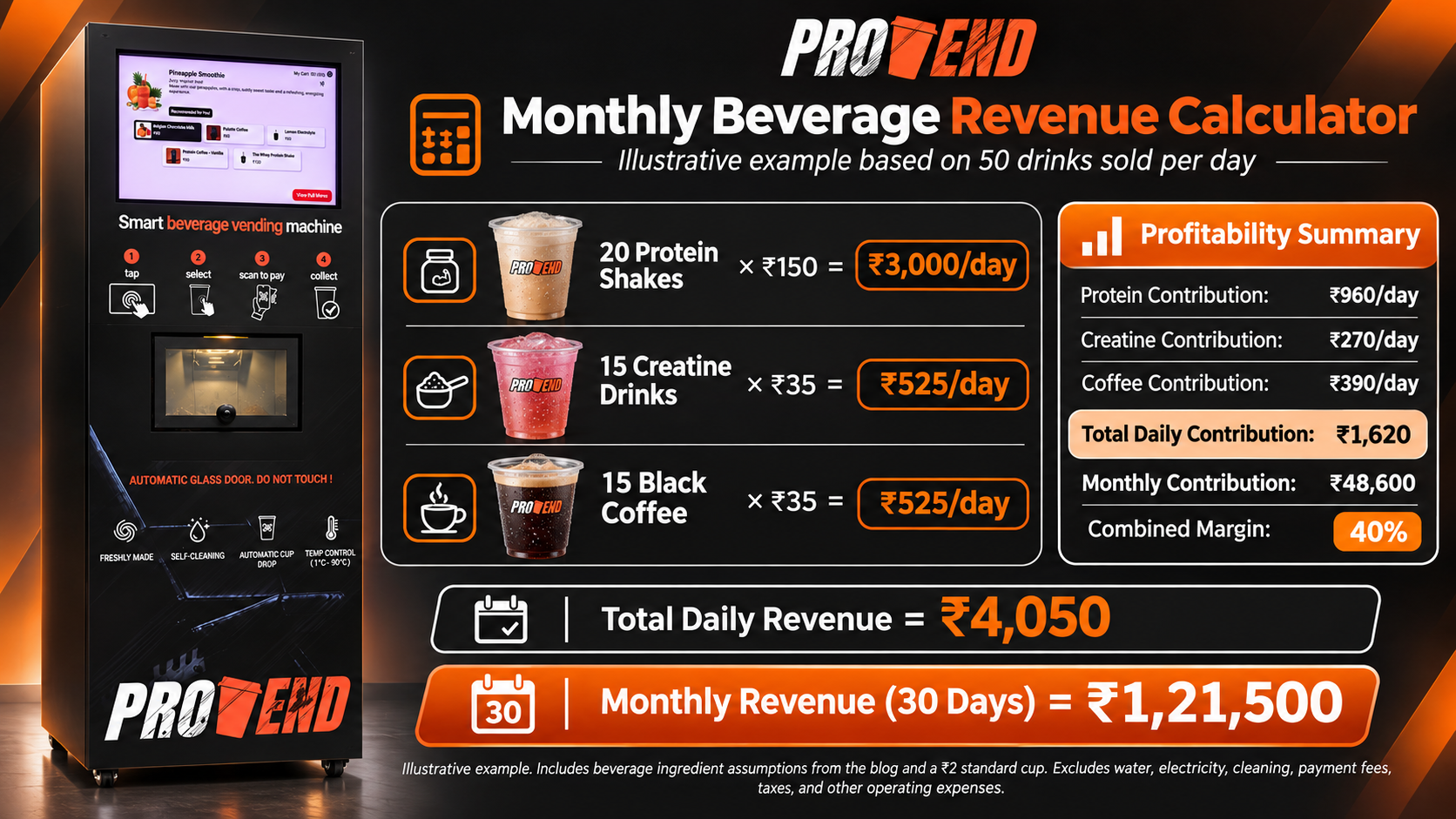
Illustrative ProVend revenue scenario: 50 drinks sold daily could generate ₹1,21,500 in monthly revenue and ₹48,600 in contribution after premix and standard cup costs, before other operating expenses.Image details
ProVend monthly beverage revenue calculator infographic illustrating a hypothetical 30-day sales scenario for a smart protein shake vending machine. The visual features the black ProVend vending machine, branded transparent beverage cups, and a breakdown of 20 protein shakes at ₹150, 15 creatine drinks at ₹35, and 15 black coffees at ₹35 sold daily. Total daily revenue is ₹4,050, resulting in ₹1,21,500 monthly revenue. After the stated premix costs and ₹2 standard cup costs, the illustrative monthly contribution is ₹48,600, representing a 40% contribution margin. These figures exclude water, electricity, cleaning, machine maintenance, payment processing, location charges, taxes, and other operating expenses. Actual results depend on pricing, customer demand and sales volume.
How Smart Beverage Machines Help Operators Manage Their Menu
A commercial beverage machine should do more than prepare drinks.
It should also help business owners manage their products efficiently.
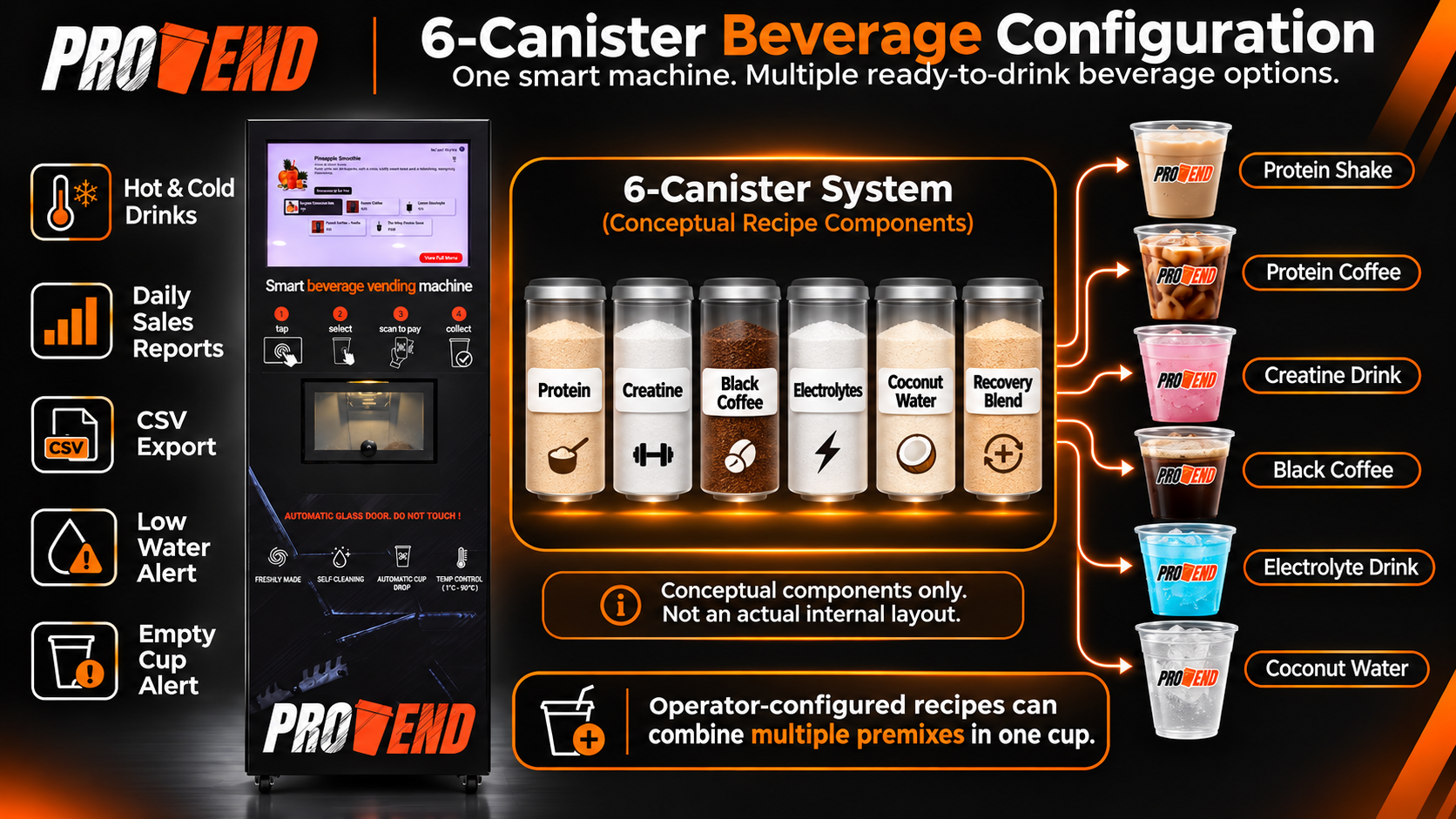
For example, ProVend's six-canister beverage system allows operators to configure finished drink recipes using compatible powdered ingredients.
A single drink can contain more than one premix when the operator has configured that combination.
Customers then select the finished drink directly from the touchscreen. They do not need to select ingredients or determine mixing quantities themselves.
Useful Operational Features
The machine supports:
Hot and cold beverage preparation
Six powdered-ingredient canisters
Operator-configured beverage recipes
Customisable touchscreen menu
Customisable screensaver
Daily drink-wise sales reports
Exportable CSV revenue reports
Low-water indication
Empty-cup indication
These capabilities help businesses understand which drinks sell well and make informed changes to their menus.
For example, a gym may discover that coffee performs better in the morning while protein shakes attract more purchases later in the day.
As a result, the operator can refine the menu based on actual sales instead of guesswork.
ProVend's six-canister beverage system supports multiple compatible premixes and operator-configured recipes for hot and cold drinks. Ingredient containers are conceptual illustrations, not actual machine internals.Image details
ProVend smart beverage vending machine infographic showcasing its six-canister multi-beverage configuration. The visual features the original black ProVend machine, a conceptual representation of six powdered ingredient containers, and transparent ProVend-branded cups displaying beverage options such as protein shakes, protein coffee, creatine drinks, black coffee, electrolyte drinks, and coconut water premix. ProVend supports operator-configured recipes that can combine compatible premixes to prepare multiple hot and cold beverages. Operational features highlighted include daily sales reports, CSV revenue exports, low-water notifications, and empty-cup alerts. The ingredient-container illustration is conceptual and does not depict actual machine internals, proprietary dispensing mechanisms, or engineering specifications. This image accompanies ProVend's blog on protein shake vending machine profit margins and multi-beverage vending profitability.
Five Ways to Improve Protein Vending Machine Profitability
1. Choose the Right Location
Even a high-margin beverage will struggle to generate meaningful revenue if customers rarely see the machine.
Gyms, fitness clubs, sports academies, and commercial workplaces can be promising locations when beverage demand is consistent.
A consistently clean machine helps protect product quality and customer trust.
Frequently Asked Questions
1. What is a good protein shake vending machine profit margin?
The margin depends on ingredient prices, selling price, and operating costs. In our example, a ₹150 protein shake containing ₹100 of premix and a ₹2 cup generates a 32% margin before additional expenses.
2. Can a vending machine really achieve a 70% margin?
Yes, certain drinks can achieve a 70% margin before all operating expenses. For example, black coffee sold at ₹30 with ₹7 of premix and a ₹2 cup produces a 70% margin on those costs.
3. Are fresh-mixed protein shakes better than RTD bottles?
Fresh-mixed shakes offer more flexibility in sourcing, recipes, and menu management. However, profitability depends on actual product costs, nutritional equivalence, and operating expenses.
4. Which beverages can generate higher vending margins?
Under the example prices used here, black coffee offers a higher percentage margin than protein or creatine drinks. Other drinks must be evaluated using their individual ingredient and serving costs.
5. Can one machine serve protein, coffee, and other beverages?
Yes. A compatible multi-beverage dispensing system can prepare several operator-configured drinks using different powdered premixes, subject to canister capacity and recipe compatibility.
6. Is beverage vending completely passive income?
No. Automated preparation reduces manual work, but operators still need to refill ingredients, maintain hygiene, monitor performance, and service the equipment.
Final Thoughts: Profitability Goes Beyond Protein
A successful protein shake vending machine profit margin strategy isn't about achieving 70% on every beverage.
Instead, it's about combining products that customers want with sensible pricing and effective cost management.
Protein shakes can form the foundation of a fitness-focused beverage business. Meanwhile, drinks such as black coffee and creatine provide additional menu opportunities with different margins.
Furthermore, flexible beverage dispensing systems allow operators to experiment with compatible premixes, seasonal products, and new recipes.
The result is a business model that can serve a broader audience while creating multiple sources of beverage revenue.
Ultimately, the most profitable menu is the one that balances customer demand, serving costs, product quality, and reliable operations.
Explore our complete collection of guides at the ProVend Blog.
Ready to Explore a Smarter Beverage Business?
Whether you're a gym owner, fitness club operator, or vending investor, understanding your beverage margins is the first step toward building a sustainable business.
At ProVend, we develop smart hot and cold beverage vending solutions that help businesses serve configurable premix-based drinks through an automated system.
Want to see how it works?
Request a ProVend demonstration and explore how a multi-beverage vending machine could fit your business.