Gym Owner vs Vending Machine Owner: Which Business Makes More Money? | ProVend
For many aspiring entrepreneurs, owning a gym seems like the perfect business opportunity. The fitness industry continues to grow, health awareness is increasing, and successful gyms often build loyal communities. However, behind every successful fitness centre lies a significant investment of time, money, and operational effort.
At the same time, another business model has quietly gained popularity among entrepreneurs looking for a more scalable and lower-maintenance way to generate recurring income: smart beverage vending machines.
If you're comparing a gym owner vs. vending machine owner, the decision isn't simply about which business earns more revenue. Instead, it's about understanding investment requirements, operating costs, day-to-day responsibilities, scalability, and long-term income potential.
Compare gym ownership with a ProVend smart beverage vending machine business to understand which model offers greater operational efficiency, scalability, and long-term passive income potential.Image details
This hero image compares two distinct business models: traditional gym ownership and owning a ProVend smart beverage vending machine business. On one side, a gym owner manages staff, equipment, member retention, and daily operations. On the other, a ProVend smart beverage station operates automatically, serving freshly prepared hot and cold beverages while requiring significantly less day-to-day involvement. The illustration highlights key differences in investment, operational effort, scalability, and recurring income potential, helping entrepreneurs evaluate which business model better aligns with their financial goals and preferred level of involvement.
The right choice depends on your goals. Some entrepreneurs enjoy managing a fitness business and building a community, while others prefer an automated business that can operate with significantly less daily involvement.
In this guide, we'll compare both business models side by side, explore their advantages and challenges, and help you determine which option aligns better with your investment strategy and lifestyle.
Is owning a vending machine business easier than owning a gym?
It depends on your goals. A gym offers opportunities to build a fitness-focused brand and community but generally requires higher capital, staff management, equipment maintenance, and daily operations. A smart beverage vending machine business typically requires less space, lower operational involvement, and can be expanded across multiple locations more easily. Entrepreneurs seeking a lower-maintenance business model often consider automated beverage solutions as an alternative way to generate recurring income.
Key Takeaways
Gym ownership and vending machine ownership follow very different business models.
Opening a gym usually requires higher upfront investment and ongoing operational management.
Smart beverage vending machines can operate in multiple commercial locations with comparatively lower daily involvement.
Scalability depends on capital, location selection, and operational efficiency rather than revenue alone.
Businesses such as gyms, offices, coworking spaces, hotels, hospitals, and educational institutions can all benefit from smart beverage stations.
Choosing the right commercial location plays a significant role in long-term success.
Your ideal business depends on whether you prefer active management or a more automated operating model.
Why More Entrepreneurs Are Looking Beyond Traditional Businesses
Starting a business has never been easier—but building one that delivers consistent returns remains a challenge.
For years, entrepreneurs interested in the fitness industry focused primarily on opening gyms. While that model continues to succeed for many operators, it also comes with ongoing responsibilities such as managing memberships, hiring trainers, maintaining equipment, handling customer service, and controlling operating costs.
Consequently, many investors are exploring business models that rely more on automation and less on daily supervision.
This is where smart beverage vending machines have attracted growing interest.
Instead of managing a full-scale fitness facility, entrepreneurs can install automated beverage stations in locations where people already gather—such as gyms, offices, coworking spaces, hotels, hospitals, universities, and retail environments. These machines prepare freshly made beverages on demand while requiring significantly less day-to-day operational effort than a traditional beverage counter.
Solutions like ProVend demonstrate how modern beverage automation can fit into a variety of commercial environments. Rather than replacing existing businesses, they complement them by providing customers with convenient access to freshly prepared hot and cold beverages while creating an additional revenue opportunity for the location.
This shift reflects a broader trend: many entrepreneurs today are not just asking "Which business earns more?" They're asking "Which business matches the lifestyle and level of involvement I want?"
Gym Owner vs. Vending Machine Owner: A Complete Business Comparison
At first glance, both businesses appear attractive because they serve health-conscious consumers and have the potential to generate recurring revenue. However, once you compare the investment, operational requirements, and scalability, the differences become much clearer.
Here's a practical comparison to help you evaluate both opportunities.
Initial Investment
One of the biggest deciding factors for any entrepreneur is the amount of capital required to get started.
Opening a gym generally involves renting or purchasing commercial space, renovating the facility, purchasing fitness equipment, installing changing rooms, obtaining licenses, and investing in marketing before welcoming the first customer.
In contrast, a smart beverage vending machine business usually requires a significantly smaller footprint. Since the machine occupies only a limited amount of floor space, entrepreneurs can install it inside existing commercial environments such as gyms, offices, coworking spaces, hospitals, hotels, educational institutions, and shopping malls.
Consequently, the overall infrastructure requirements are considerably lower.
While the exact investment depends on the business model and equipment selected, entrepreneurs typically appreciate the flexibility of starting with one machine and expanding gradually as demand grows.
Investment Comparison
Factor
Gym Business
Smart Beverage Vending Business
Initial Investment
High
Moderate
Commercial Space
Large
Small
Interior Setup
Extensive
Minimal
Staff Required
Multiple
Usually Minimal
Equipment Maintenance
High
Moderate
Expansion Cost
High
Incremental
Takeaway: If your primary goal is to start with a lower operational footprint and scale progressively, an automated beverage business can offer greater flexibility.
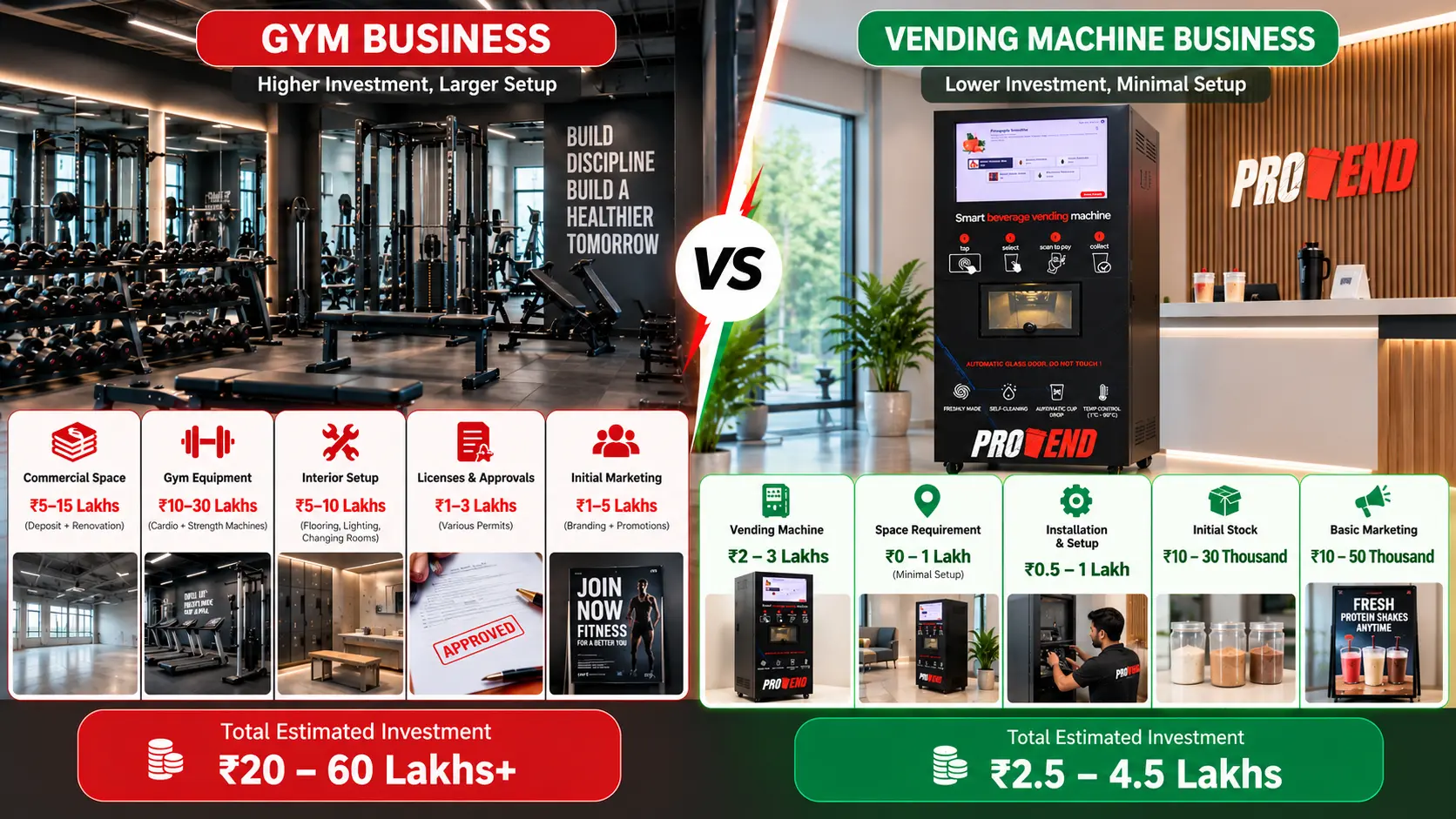
Compare the estimated startup costs of opening a gym with launching a ProVend smart beverage vending machine business to understand which offers a lower investment barrier and greater scalability.Image details
This infographic compares the estimated startup investment required to open a traditional gym versus starting a ProVend smart beverage vending machine business. It highlights major cost categories, including commercial space, equipment, interior setup, staffing, licenses, marketing, and the total estimated investment. The comparison demonstrates how a smart beverage vending machine business typically requires a significantly lower initial investment, smaller floor space, and fewer operational resources, making it an attractive option for entrepreneurs seeking a scalable and recurring-income business model. The visual supports readers in evaluating the financial commitment associated with each business before making an investment decision.
Daily Operations: Active Business vs. Automated Business
Many first-time entrepreneurs focus only on revenue potential. However, long-term success often depends on how much time the business demands every day.
Gym ownership is a hands-on business.
A typical day may include:
Managing memberships
Supervising trainers
Handling customer queries
Maintaining fitness equipment
Scheduling classes
Managing housekeeping
Coordinating repairs
Running promotional campaigns
As a result, the owner's involvement often extends beyond normal business hours.
An automated smart beverage station operates differently.
Once installed in a suitable location, the business primarily revolves around:
Monitoring inventory
Refilling beverage premixes
Scheduling preventive maintenance
Reviewing sales data
Maintaining hygiene standards
Modern systems also include features such as digital payment support, automated beverage preparation, self-cleaning functions, and remote performance monitoring, reducing manual intervention.
Platforms like ProVend further demonstrate how beverage automation can simplify daily operations by combining intelligent dispensing technology with commercial-grade reliability.
That doesn't mean the business runs without any effort. Regular servicing, stock planning, and location management remain important. However, compared to managing a full-scale gym, the day-to-day workload is generally much lower.
Time Commitment
Time is one of the most overlooked costs of running any business.
A gym often operates from early morning until late evening to accommodate different customer schedules. Many owners spend weekends resolving operational issues, responding to customer concerns, and overseeing staff.
In comparison, an automated beverage vending business allows owners to focus more on business expansion than daily operations.
Instead of being tied to one physical location all day, entrepreneurs can spend their time identifying new commercial locations, improving customer experience, and increasing machine deployment.
Therefore, the business becomes increasingly scalable as additional locations are added.
Time Comparison
Activity
Gym Owner
Vending Machine Owner
Staff Supervision
High
Low
Customer Handling
High
Low
Inventory Management
Medium
Medium
Daily Presence Required
High
Low
Expansion Planning
Limited by Time
Highly Scalable
Revenue Model
Although both businesses generate recurring income, they do so in fundamentally different ways.
A gym relies heavily on:
Monthly memberships
Personal training sessions
Group classes
Merchandise
Supplement sales
Revenue can fluctuate based on member retention, seasonal demand, competition, and cancellations.
On the other hand, a smart beverage vending business earns revenue from beverage sales made throughout the day.
The more suitable the location and customer footfall, the greater the opportunity for recurring sales.
For example, placing a beverage station in locations where people naturally seek refreshments—such as fitness centres, offices, hospitals, universities, hotels, and coworking spaces—can create consistent demand without requiring customers to purchase long-term memberships.
This is one reason why choosing the right installation location remains one of the most important success factors. If you haven't already, our previous guide on Best Places to Install a Vending Machine explores how location selection can significantly influence long-term performance and recurring sales.
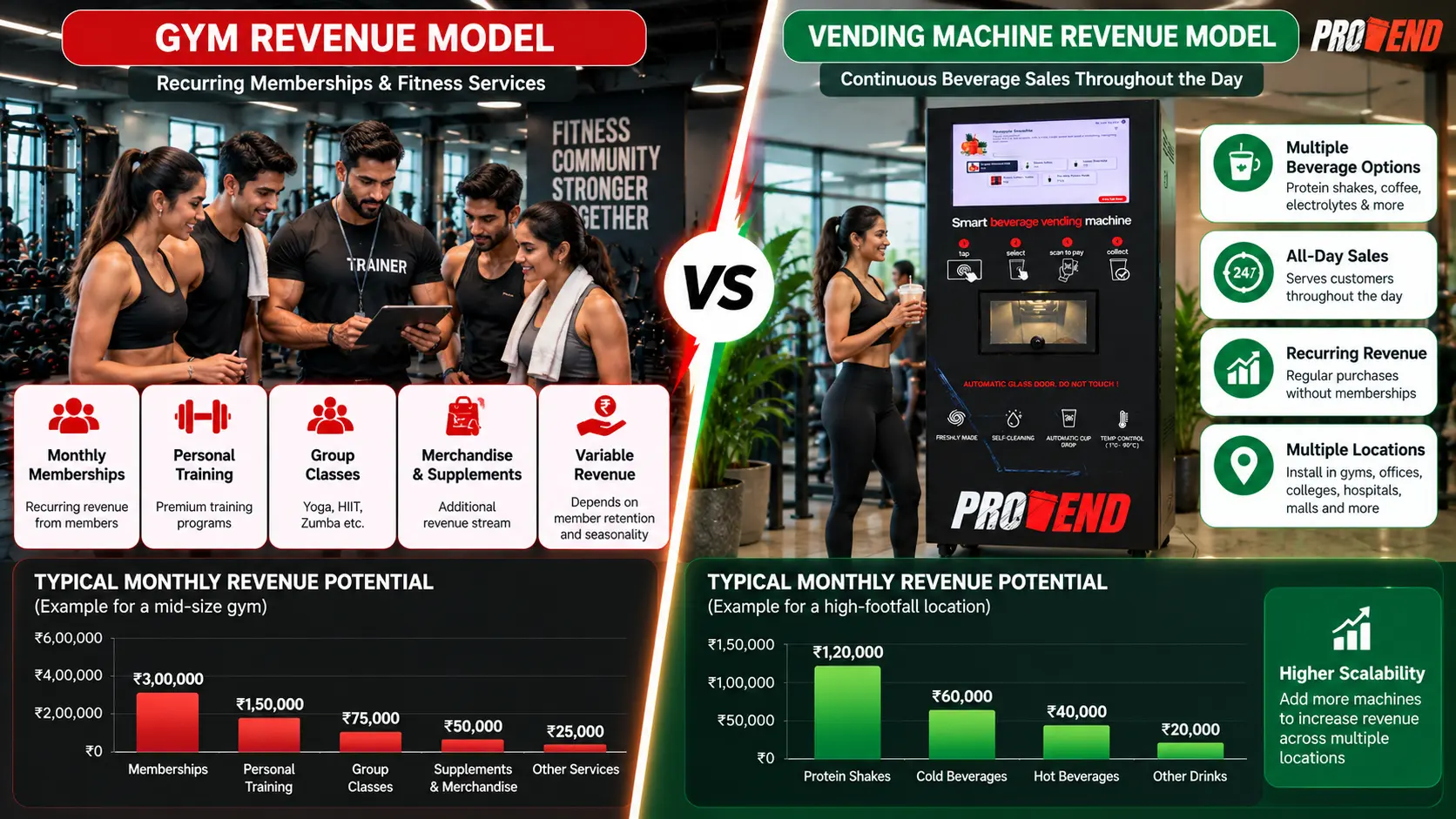
Compare how a traditional gym earns through memberships and services versus how a ProVend smart beverage vending machine generates recurring beverage sales throughout the day.Image details
This infographic compares the revenue models of a traditional gym business and a ProVend smart beverage vending machine business. The left side illustrates how gyms generate income through monthly memberships, personal training, group fitness classes, merchandise, and supplement sales, with revenue depending heavily on customer retention and operational management. The right side highlights how a ProVend smart beverage station creates recurring revenue through continuous beverage sales, offering multiple drink options, automated operation, digital payments, and easy deployment across gyms, offices, coworking spaces, hospitals, hotels, universities, and shopping malls. The comparison demonstrates how beverage vending businesses can provide a scalable, lower-maintenance revenue model while generating consistent income throughout the day.
Which Business Scales Faster?
Growth is where automated business models often stand out.
Opening a second gym usually means repeating a substantial investment in property, equipment, staff recruitment, and operations.
Conversely, many vending machine businesses scale by adding machines to additional commercial locations.
Each new installation can contribute to overall revenue while benefiting from similar operational processes already established for existing machines.
As a result, entrepreneurs can often diversify across multiple locations instead of depending on a single business outlet.
That said, successful scaling still requires careful planning, location analysis, inventory management, and ongoing maintenance.
Profit Potential: Which Business Can Generate Better Long-Term Returns?
One of the biggest questions entrepreneurs ask is, "Which business actually makes more money?"
The answer isn't as simple as comparing monthly revenue. A business generating higher sales doesn't necessarily produce higher profits. Operating expenses, staffing, rent, maintenance, and time commitment all affect your actual earnings.
A gym can generate substantial revenue through memberships, personal training, group classes, and supplement sales. However, it also comes with considerable ongoing costs, including employee salaries, utility bills, equipment servicing, facility maintenance, insurance, and marketing.
By contrast, a smart beverage vending business typically operates with fewer recurring expenses. Since many routine processes are automated, owners can often focus more on optimizing locations and increasing sales than managing a large workforce.
Therefore, when evaluating profitability, it's important to consider net returns rather than gross revenue.
Understanding Profit Margins
Every business has fixed and variable expenses.
For a gym, these often include:
Commercial rent or lease payments
Trainer and administrative salaries
Electricity and air conditioning
Equipment maintenance
Cleaning and housekeeping
Marketing campaigns
Membership management software
Insurance and licenses
For a smart beverage vending business, recurring expenses are generally more streamlined:
Beverage premixes and consumables
Routine machine maintenance
Electricity
Internet connectivity (if applicable)
Revenue sharing or rental agreements (depending on the location)
Periodic servicing
Because the operational structure is simpler, entrepreneurs can often predict expenses more easily and expand without proportionally increasing management complexity.
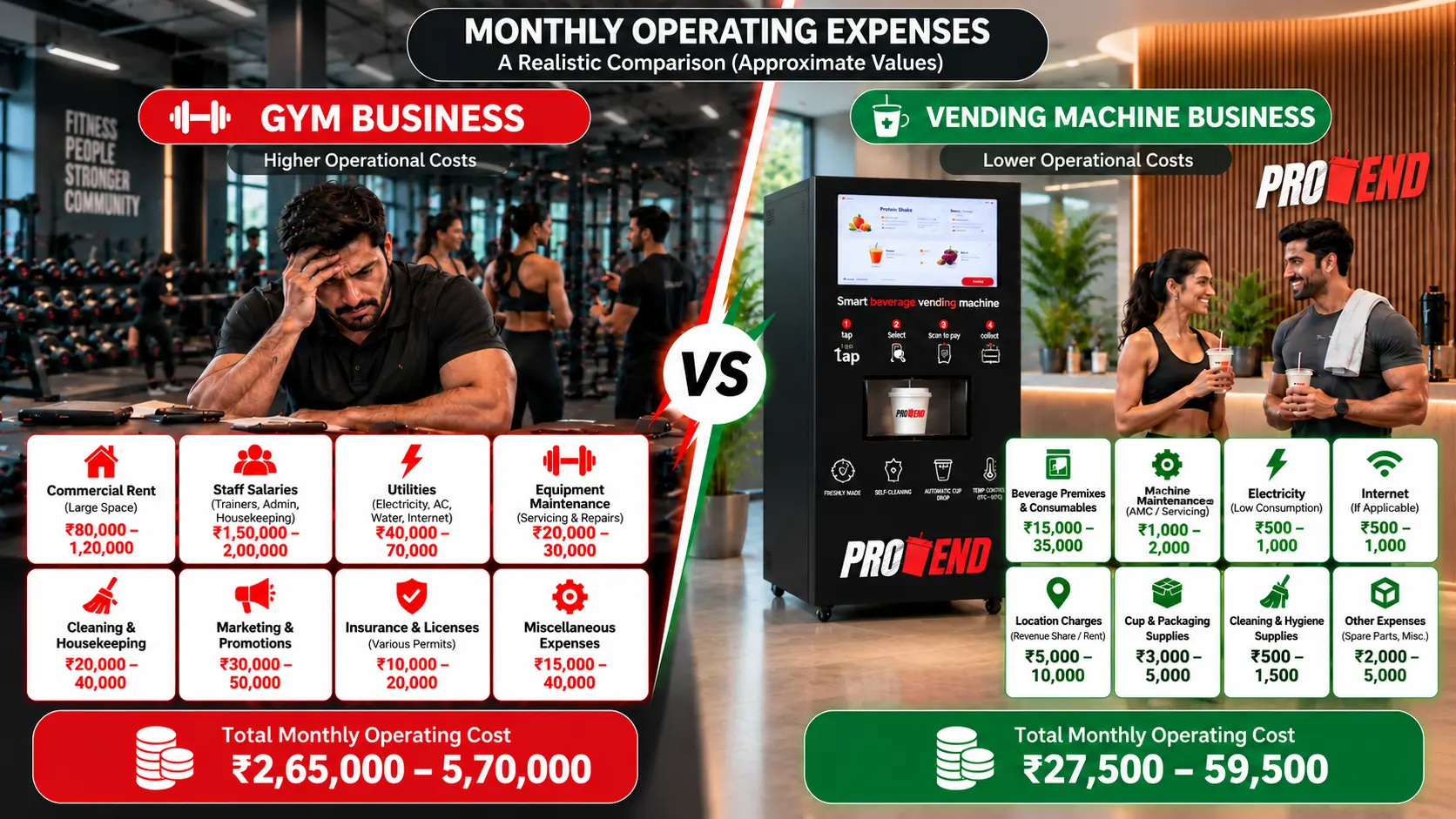
Compare the monthly operating costs of a gym with a ProVend smart beverage vending machine business to understand how automation can reduce recurring expenses and simplify operations.Image details
This infographic compares the typical monthly operating expenses of a traditional gym business with those of a ProVend smart beverage vending machine business. The gym side outlines major recurring costs such as commercial rent, staff salaries, utilities, equipment maintenance, cleaning, marketing, insurance, and miscellaneous operational expenses. The ProVend side highlights streamlined expenses including beverage premixes, machine maintenance, electricity, internet connectivity, location charges or revenue sharing, packaging supplies, hygiene products, and other operating costs. The visual demonstrates how a smart beverage vending business generally requires lower monthly operational expenditure, making it an attractive option for entrepreneurs seeking a scalable, technology-driven business with recurring revenue and reduced day-to-day management.
Can a Vending Machine Business Really Generate Passive Income?
This is one of the most common questions people ask online.
The honest answer is:
Not completely—but it can become significantly more automated than many traditional businesses.
No legitimate business is entirely passive. Every business requires planning, inventory management, customer support when needed, maintenance, and performance monitoring.
However, compared with managing a gym every day, a smart beverage station can reduce the amount of direct operational involvement.
Once installed in a suitable location with consistent footfall, owners primarily focus on:
Refilling beverage premixes
Scheduling maintenance
Reviewing sales reports
Monitoring inventory
Expanding into additional locations
As technology continues to improve, features such as cashless payments, automated dispensing, remote monitoring, and self-cleaning systems further simplify operations.
Solutions like ProVend demonstrate how modern beverage automation enables entrepreneurs to operate multiple commercial locations without the same daily workload associated with managing a traditional fitness facility.
Business Risks: Every Investment Has Trade-Offs
Every business carries risk.
The key is understanding which risks you're more comfortable managing.
Fortunately, many of these risks can be reduced through careful planning and location selection.
For example, businesses located in offices, gyms, coworking spaces, hospitals, hotels, educational institutions, and commercial complexes often experience more consistent daily traffic than isolated locations.
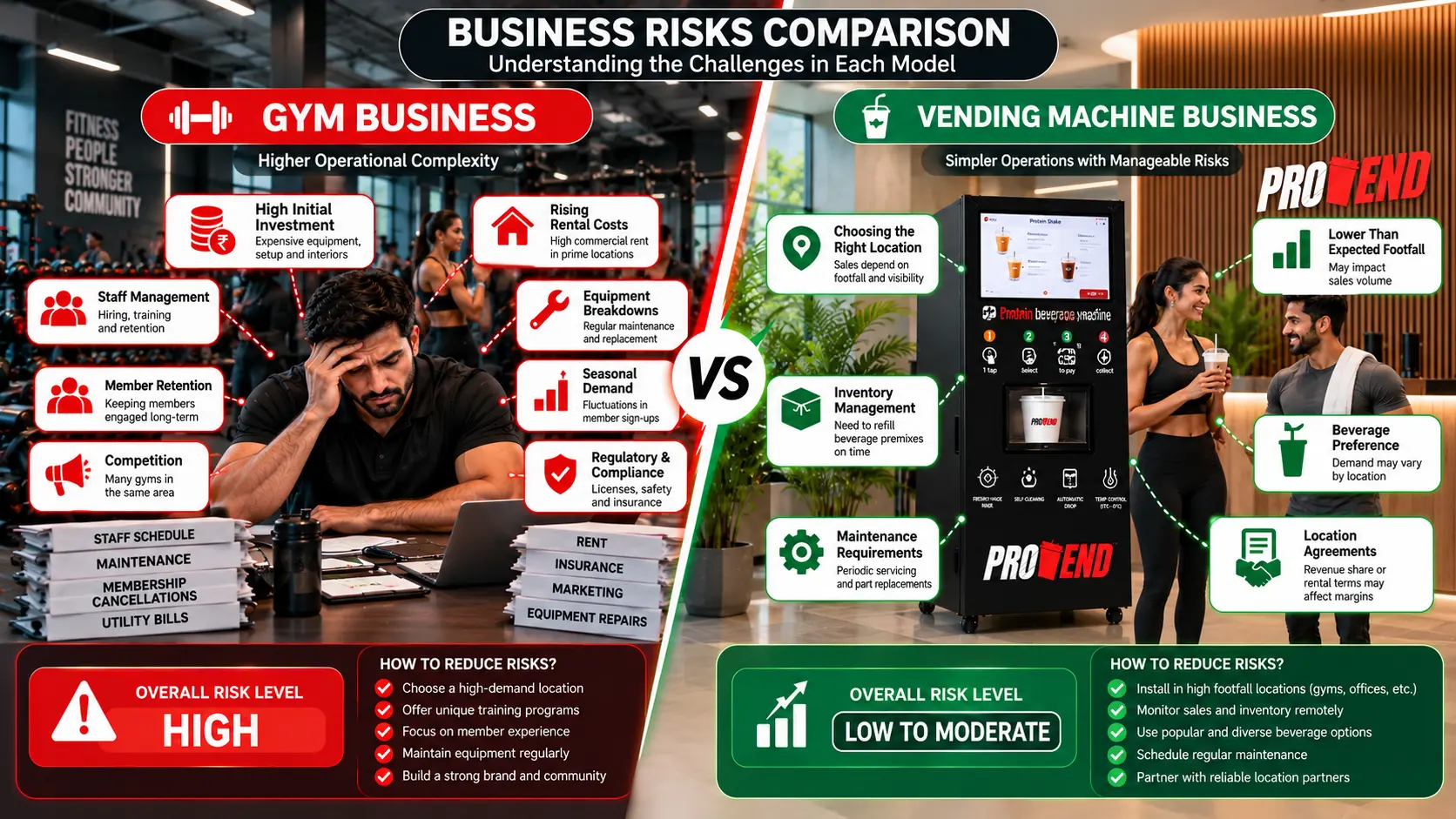
Compare the operational risks of running a traditional gym with a ProVend smart beverage vending machine business to understand how automation can simplify business management.Image details
This infographic presents a side-by-side comparison of the operational risks associated with owning a traditional gym versus operating a ProVend smart beverage vending machine. The left side illustrates a gym owner managing multiple responsibilities, including staff, member retention, equipment maintenance, rising operational costs, and daily facility management. The right side showcases a ProVend smart beverage vending machine installed in a modern commercial environment, emphasizing automation, digital payments, remote monitoring, self-cleaning functionality, minimal staffing requirements, and easier day-to-day operations. The comparison demonstrates how beverage vending automation can reduce operational complexity while creating recurring revenue opportunities, making it an attractive business model for entrepreneurs, investors, and commercial property owners.
Who Should Choose a Gym Business?
A traditional gym may be the better choice if you:
Enjoy working directly with people
Want to build a fitness-focused community
Are comfortable managing employees
Have sufficient investment capital
Prefer an active, hands-on business
Gym ownership can be highly rewarding for entrepreneurs who are passionate about health, fitness, and customer engagement.
Who Should Consider a Smart Beverage Vending Business?
An automated beverage vending business may be a strong fit if you:
Prefer a business with lower daily operational involvement
Want to start with a comparatively smaller commercial footprint
Plan to expand across multiple locations over time
Appreciate technology-driven operations
Are looking for a business that can generate recurring sales through automation
This model appeals to entrepreneurs, investors, facility owners, and businesses looking to make better use of commercial spaces while providing customers with convenient beverage options.
Choosing the Right Location Is Still the Biggest Success Factor
Regardless of the business model you choose, location has a major influence on performance.
For beverage vending businesses, installing machines where people naturally spend time significantly increases the opportunity for consistent sales.
Popular commercial environments include:
Corporate offices
Gyms and fitness centres
Coworking spaces
Hospitals
Universities and colleges
Hotels
Shopping malls
Manufacturing facilities
Transportation hubs
If you're evaluating where a beverage station performs best, you may also find our guide on Best Places to Install a Vending Machine helpful. It explores how footfall, customer behaviour, and commercial environments influence vending machine success.
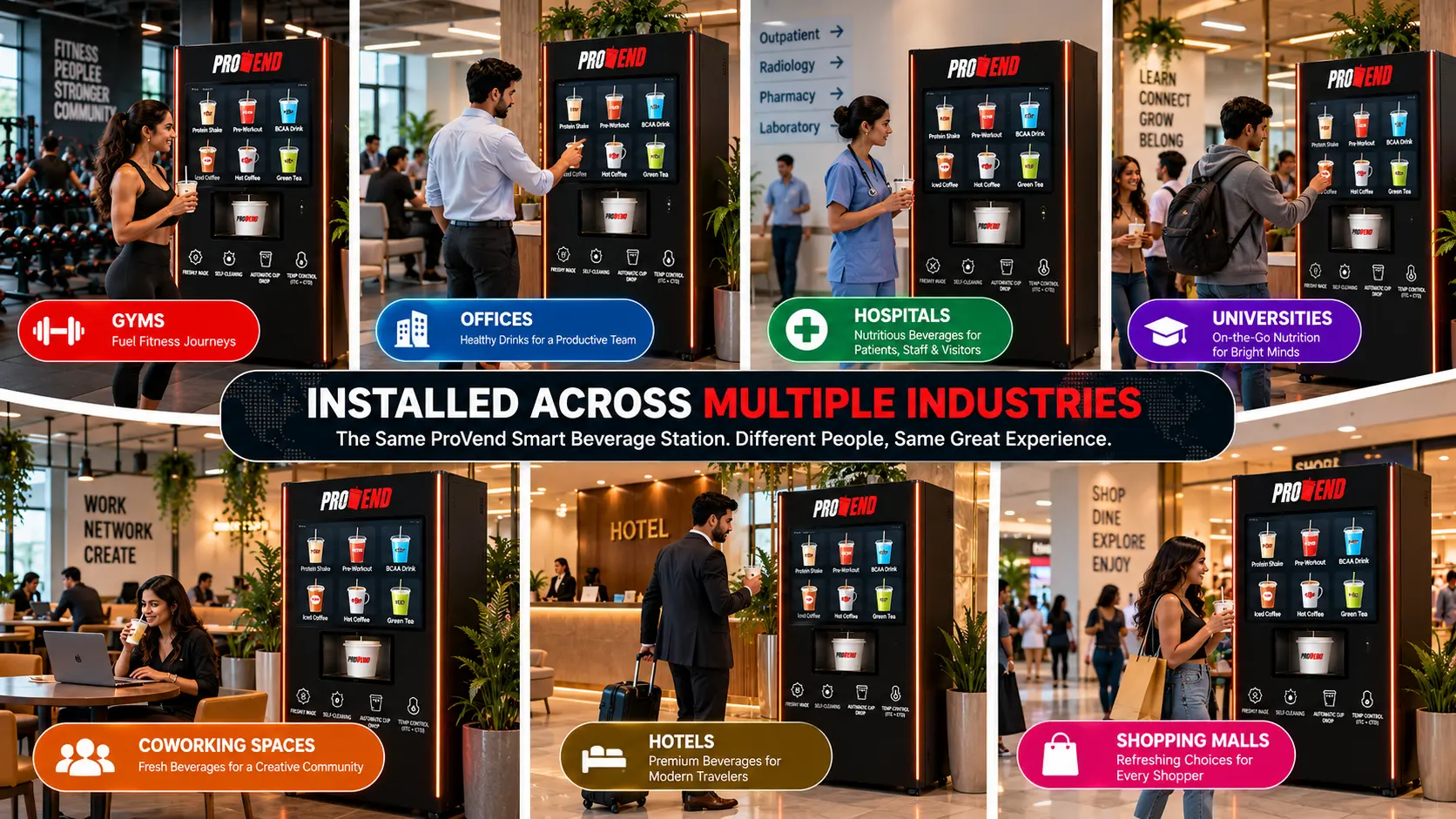
The same ProVend smart beverage station seamlessly fits into gyms, offices, hospitals, universities, coworking spaces, hotels, and shopping malls, helping businesses enhance customer experience while creating recurring revenue opportunities.Image details
This collage showcases the ProVend smart beverage vending machine successfully installed across a variety of commercial environments, including gyms, corporate offices, hospitals, universities, coworking spaces, hotels, and shopping malls. Each installation demonstrates how the same smart beverage station adapts to different customer needs while providing fresh beverages through a modern, automated, cashless experience. The image highlights the flexibility and scalability of the ProVend solution, making it suitable for businesses looking to improve customer convenience, increase workplace amenities, and unlock recurring revenue from underutilized commercial spaces. It reinforces that a single intelligent beverage vending platform can serve diverse industries without requiring major operational changes, making it an ideal investment for entrepreneurs, facility managers, and commercial property owners.
Expert Perspective
Rather than asking "Which business makes more money?", experienced entrepreneurs often ask:
"Which business matches my available time, investment capacity, and long-term growth strategy?"
A gym can become an outstanding business for owners who enjoy managing teams and building a fitness community.
A smart beverage vending business, on the other hand, may suit entrepreneurs seeking operational efficiency, scalability, and recurring revenue through automation.
Neither option is universally better.
The best business is the one that aligns with your goals, resources, and preferred level of involvement.
Conclusion
The comparison between a gym owner vs. vending machine owner isn't about declaring a winner—it's about understanding two fundamentally different entrepreneurial journeys.
Gym ownership offers the opportunity to build a community and operate a hands-on business but requires significant time, investment, and ongoing management.
Smart beverage vending businesses provide a different path. By combining automation, strategic location selection, and scalable deployment, entrepreneurs can create a recurring revenue model with comparatively lower day-to-day operational demands.
Innovative solutions like ProVend reflect how beverage automation is evolving beyond simple vending machines into intelligent commercial amenities that serve customers while helping businesses unlock additional revenue opportunities.
Whether you're an aspiring entrepreneur, commercial property owner, or existing business looking to diversify your income, evaluating your goals, available capital, and preferred level of involvement will help you choose the business model that's right for you.
Frequently Asked Questions (FAQ)
Is owning a vending machine easier than owning a gym?
Generally, a vending machine business requires less daily operational involvement than managing a gym, although both businesses require planning, maintenance, and ongoing management.
Can a beverage vending machine generate passive income?
It can generate recurring income with relatively lower daily involvement, but no business is completely passive. Inventory, maintenance, and performance monitoring remain essential.
Where is the best place to install a smart beverage vending machine?
Can I start with one vending machine and expand later?
Yes. Many entrepreneurs begin with a single installation and gradually add more machines as they gain experience and identify new commercial locations.
📚 Continue Learning with ProVend
If you're exploring beverage vending machines, passive income opportunities, or commercial space monetization, these guides will help you make more informed business decisions.
Interested in exploring how an automated beverage business could fit your commercial space or investment goals?
Request a demo from ProVend to see how smart beverage vending technology can help create a modern customer amenity while opening the door to recurring revenue opportunities.