Beverage Vending Machine vs Hiring Staff | ProVend
Beverage vending machine vs hiring staff: compare monthly costs, maintenance, and service availability to find the right option for your business.
Compare hiring beverage staff with ProVend automated vending machines to understand operating costs, service hours, maintenance, and long-term business value.Image details
This ProVend blog hero image illustrates the comparison between hiring dedicated beverage preparation staff and installing an automated beverage vending machine. Featuring a gym shake bar employee and a ProVend smart vending machine, the visual highlights key business considerations such as operating expenses, service availability, maintenance requirements, and long-term value for gyms, offices, and commercial facilities.
Explore this article 12 sections
Beverage Vending Machine vs Hiring Staff: Which Costs Less?
Is it better to hire someone to prepare drinks or invest in an automated beverage machine? Here's what business owners should compare before spending money.
Imagine running a gym where members regularly ask for protein shakes after their workouts.
At first, hiring someone to prepare drinks seems like the obvious choice. However, once you account for salaries, shift coverage, training, and daily supervision, the decision becomes more complicated.
That's why the beverage vending machine vs hiring staff comparison matters for businesses trying to offer drinks without unnecessarily increasing operating costs.
A smart vending machine can automate repetitive beverage preparation. Meanwhile, an employee can provide personalised service and handle tasks that machines cannot.
So, which option makes better financial sense?
The answer depends on your business, customer demand, and operating hours.
Beverage Vending Machine vs Hiring Staff: Quick Comparison
Before looking at the numbers, consider how each option works in practice.
Factor
Hiring Beverage Staff
Automated Beverage Machine
Initial investment
Usually lower
Equipment purchase or lease
Recurring expenses
Salary, benefits, training
Ingredients, power, maintenance, equipment cost
Service hours
Depend on staff shifts.
Can operate beyond staffed hours
Drink preparation
Manual
Automated for supported beverages
Personalisation
Greater flexibility
Limited to supported menu options
Cleaning
Performed by employees
Still requires scheduled human cleaning
Scaling
May require additional staff
May require additional machines or servicing
Customer interaction
Personal assistance
Self-service
Neither option wins in every situation.
For example, a café built around handcrafted beverages may benefit from experienced baristas. On the other hand, a gym selling a consistent menu of protein shakes and coffee may find automated preparation more practical.
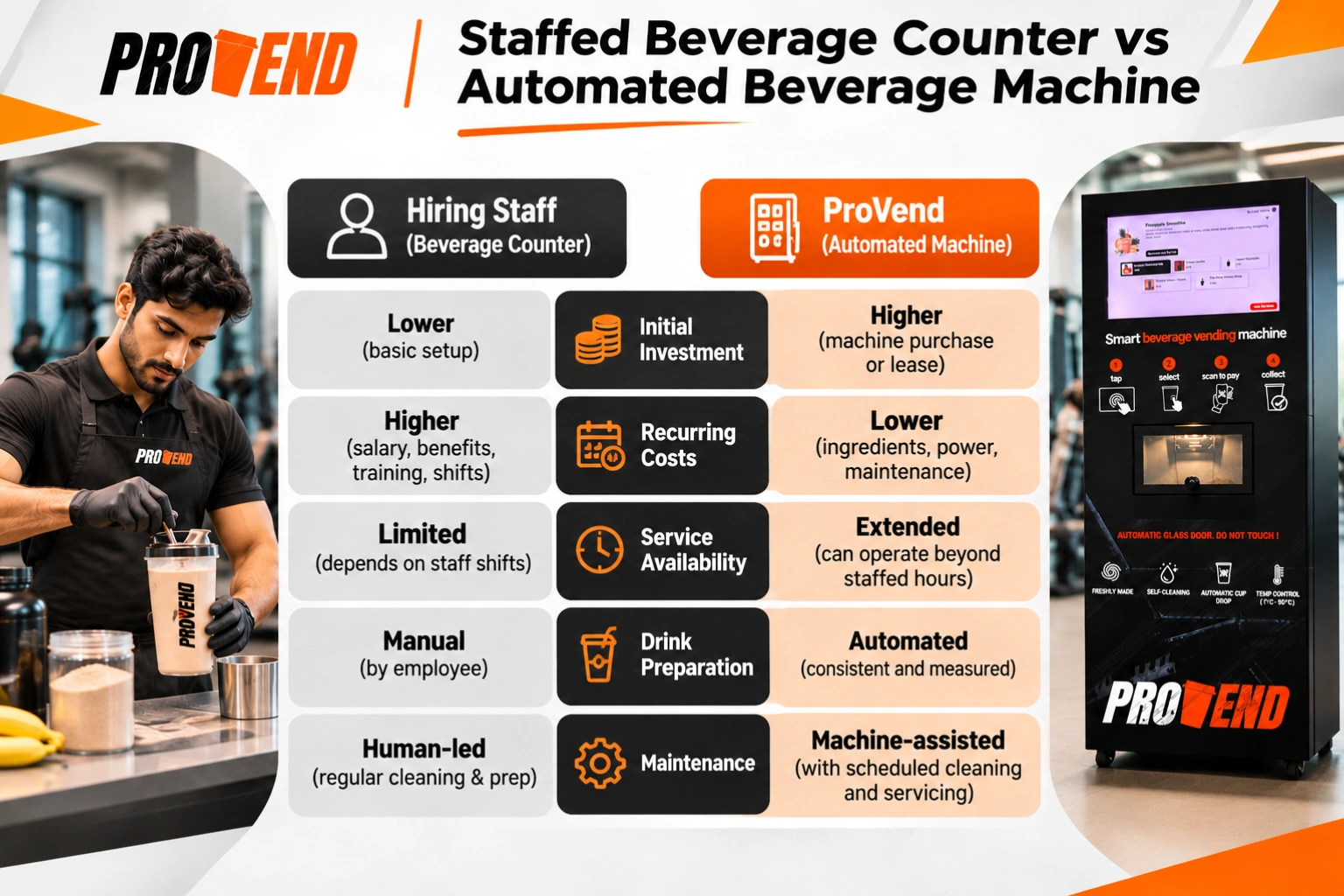
Compare a staffed beverage counter with a ProVend automated vending machine across investment, operating expenses, service hours, preparation and maintenance.Image details
This ProVend comparison infographic illustrates the operational differences between hiring staff for a beverage counter and using an automated beverage vending machine. It compares initial investment, recurring expenses, service availability, drink preparation and maintenance requirements. Designed for gym owners, office managers and commercial businesses evaluating automated beverage service, the infographic highlights important considerations without assuming guaranteed cost savings.
The Real Cost of Hiring Someone to Prepare Drinks
Hiring an employee involves more than paying a monthly salary.
Depending on the business and applicable employment rules, the total cost may include wages, statutory contributions, paid leave, training, uniforms, supervision, and replacement coverage.
Additionally, businesses with long operating hours may need multiple shifts.
Consider a gym that opens at 6 AM and closes at 11 PM.
One employee cannot realistically cover every operating hour indefinitely. Therefore, the owner must either arrange additional coverage or limit beverage-counter hours.
Even when sales are slow, the staffing expense continues.
This doesn't mean employees are unnecessary. In fact, trained staff can improve customer experience, answer questions, and manage complex orders.
However, if much of their time goes into preparing the same few beverages repeatedly, automation deserves consideration.
What Does an Automated Beverage Vending Machine Actually Cost?
A beverage vending machine has a different expense structure.
Instead of paying someone to prepare every drink, the business invests in equipment that handles compatible beverage preparation automatically.
Nevertheless, the machine isn't free to operate.
Owners should account for equipment purchase or lease payments, ingredients, cups, electricity, water, cleaning, servicing, payment charges, and potential downtime.
For instance, a premix-based beverage vending machine may dispense measured ingredients, combine them with water, and serve the finished drink.
That reduces manual preparation work. However, someone must still refill ingredients, inspect the equipment, and maintain hygiene.
The important question isn't whether a machine eliminates expenses.
It's whether the machine's total operating cost makes sense for the number of drinks you expect to sell.
Monthly Cost Comparison: Hiring Staff vs a Vending Machine
Let's use a hypothetical example for an Indian business.
Suppose a gym sells 30 beverages per day and operates for 30 days each month.
That means approximately 900 drinks per month.
The figures below are illustrative assumptions, not actual ProVend machine pricing, supplier quotations, or statutory wage benchmarks.
Monthly expense
Staffed Counter
Automated Machine
Dedicated beverage staff
₹22,000
₹0
Training, cover and staff-related allowance
₹3,000
₹0
Equipment or lease allocation
₹2,000
₹12,000
Cleaning, electricity and maintenance
₹2,000
₹4,000
Total fixed operating allocation
₹29,000
₹16,000
In this scenario, the automated machine has a ₹13,000 lower monthly fixed-cost allocation.
However, this is not a guaranteed saving.
The example excludes ingredients, cups, payment fees, taxes, premises costs, and other variable expenses. It also assumes that the business can operate the machine without additional dedicated preparation staff.
For the staffed counter, the example includes an equipment allocation. For the automated option, the ₹12,000 figure represents a hypothetical monthly lease or ownership-cost allocation—not a ProVend quotation.
Actual wages also vary by location, job classification, and applicable regulations. India's Ministry of Labour and Employment explains that both central and state governments have roles in setting minimum wages. See the government's explanation of minimum wage implementation.
What Happens When Beverage Sales Increase?
At 900 drinks per month, the hypothetical fixed-cost allocation works out to approximately:
Staffed counter: ₹32.22 per drink
Automated machine: ₹17.78 per drink
These figures exclude variable costs.
Additionally, a machine's economics may improve as more drinks are sold, provided its capacity and servicing arrangements can support the volume.
However, if sales are very low, the equipment cost may be difficult to justify.
That's why owners should calculate expected demand before making an investment.
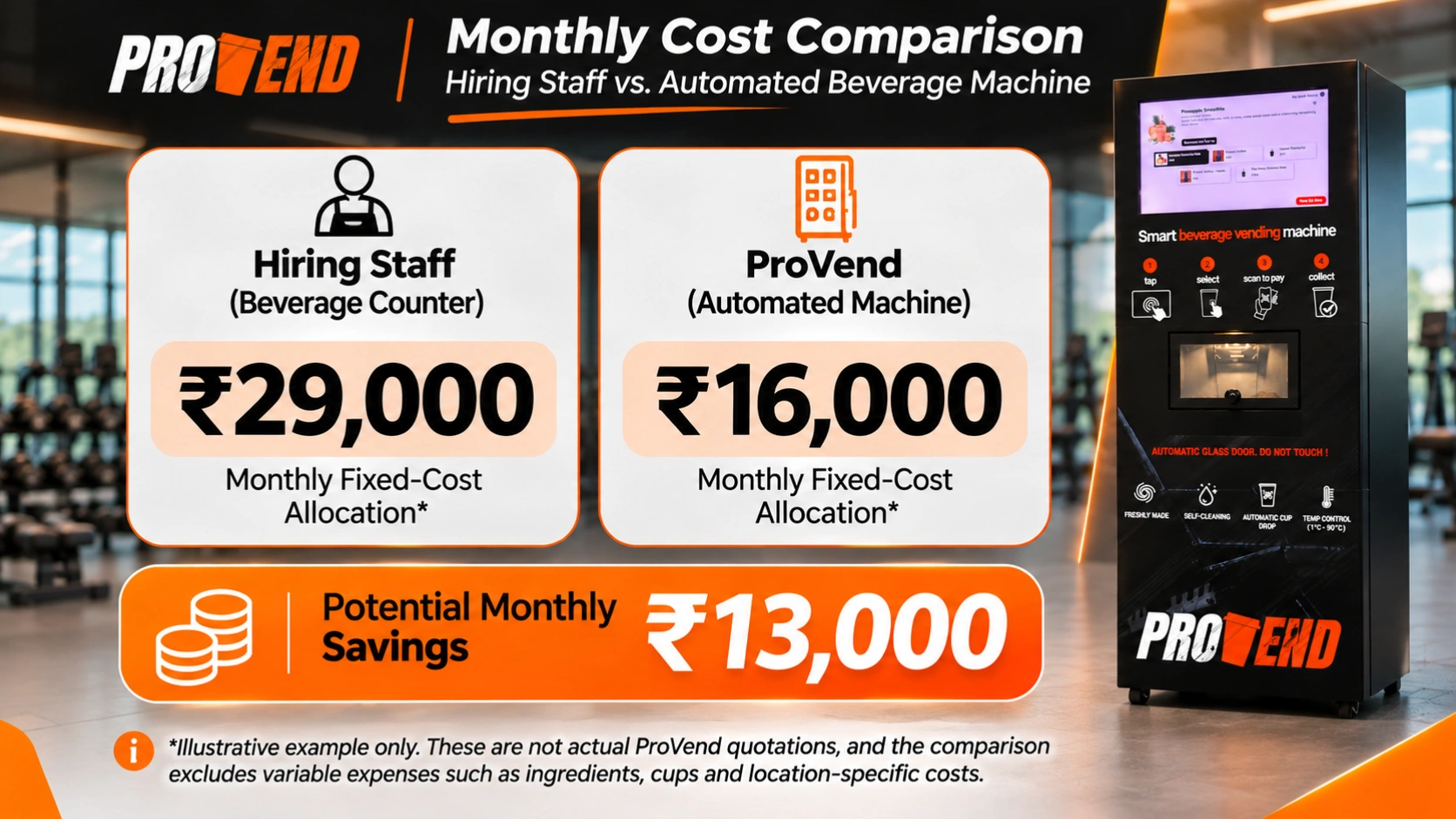
Illustrative monthly fixed costs: ₹29,000 for a staffed beverage counter versus ₹16,000 for an automated machine, showing a potential ₹13,000 difference before variable expenses.Image details
This ProVend infographic compares the hypothetical monthly fixed-cost allocation of operating a staffed beverage counter with an automated beverage vending machine. The example shows ₹29,000 for hiring staff and ₹16,000 for automation, representing a potential monthly difference of ₹13,000. The comparison helps gym owners, office managers, and commercial businesses understand beverage service operating costs. These figures are illustrative, exclude variable expenses such as ingredients and cups, and do not represent actual ProVend quotations or guaranteed savings.
Five Situations Where Automated Beverage Vending Makes Sense
1. Gyms With Repetitive Beverage Orders
Many fitness centres sell a relatively predictable selection of drinks.
Protein shakes, coffee, and hydration beverages are examples of products that may be suitable for automated premix-based preparation.
As a result, staff can focus on member assistance, training support, and facility operations rather than preparing every drink manually.
2. Offices With Busy Beverage Breaks
Office employees often want a quick drink without waiting for someone to prepare it.
An automated beverage station can provide self-service convenience during suitable operating hours.
Meanwhile, facility managers can assess whether automation fits their pantry budget, employee preferences, and existing catering arrangements.
A 24-hour gym may stay open even when its reception desk is unattended.
In that situation, an automated machine can offer beverage access outside normal counter hours, provided the machine is stocked, operational, and safely maintained.
4. Facilities With Limited Floor Space
Not every business has room for a dedicated shake bar.
A vending machine may fit into a compact, accessible area without requiring a full preparation counter.
Managing beverage staff across several facilities can become complicated.
Automated machines may help standardise supported beverage preparation and reduce repetitive manual tasks.
Additionally, connected systems may offer sales reporting and machine-status information, depending on the actual equipment and software configuration.
When Hiring Staff Is the Better Choice
Automation isn't always the right answer.
A skilled employee can prepare custom recipes, respond to unusual requests, recommend products, and build relationships with customers.
For example, a premium café that depends on handcrafted beverages and personal service may not benefit from replacing its barista with a vending machine.
Similarly, a gym with very low beverage demand might not sell enough drinks to justify a dedicated automated station.
In those situations, a staffed counter, shared employee responsibilities, or a smaller beverage offering may be more economical.
Therefore, business owners should avoid treating automation as a universal replacement for people.
Often, the strongest approach combines human service with automation.
What About Cleaning, Maintenance and Food Safety?
This is one area where business owners should be especially careful.
An automated beverage machine doesn't eliminate hygiene responsibilities.
Someone still needs to inspect ingredient storage, replenish consumables, maintain water quality, follow cleaning procedures, and respond to equipment faults.
In India, food businesses must also consider applicable FSSAI licensing and hygiene requirements. The FSSAI hygiene guidance explains food-safety management responsibilities.
Consequently, a machine should be evaluated not only by its features but also by its cleaning process, servicing requirements, and support arrangements.
A lower operating cost is only useful when the beverage service remains safe and reliable.
How ProVend Approaches Automated Beverage Preparation
At ProVend, we're developing smart beverage vending solutions for gyms, workplaces, and commercial environments.
Our machines are designed around automated preparation of compatible premix-based drinks, including protein shakes, coffee, tea, and hydration beverages.
Instead of requiring someone to manually prepare every order, the machine handles the supported beverage preparation process.
For businesses, this creates an alternative to running a traditional staffed beverage counter.
However, the right choice still depends on beverage demand, installation conditions, operating costs, and maintenance arrangements.
We believe automation works best when it solves a genuine operational problem—not simply because the technology looks impressive.
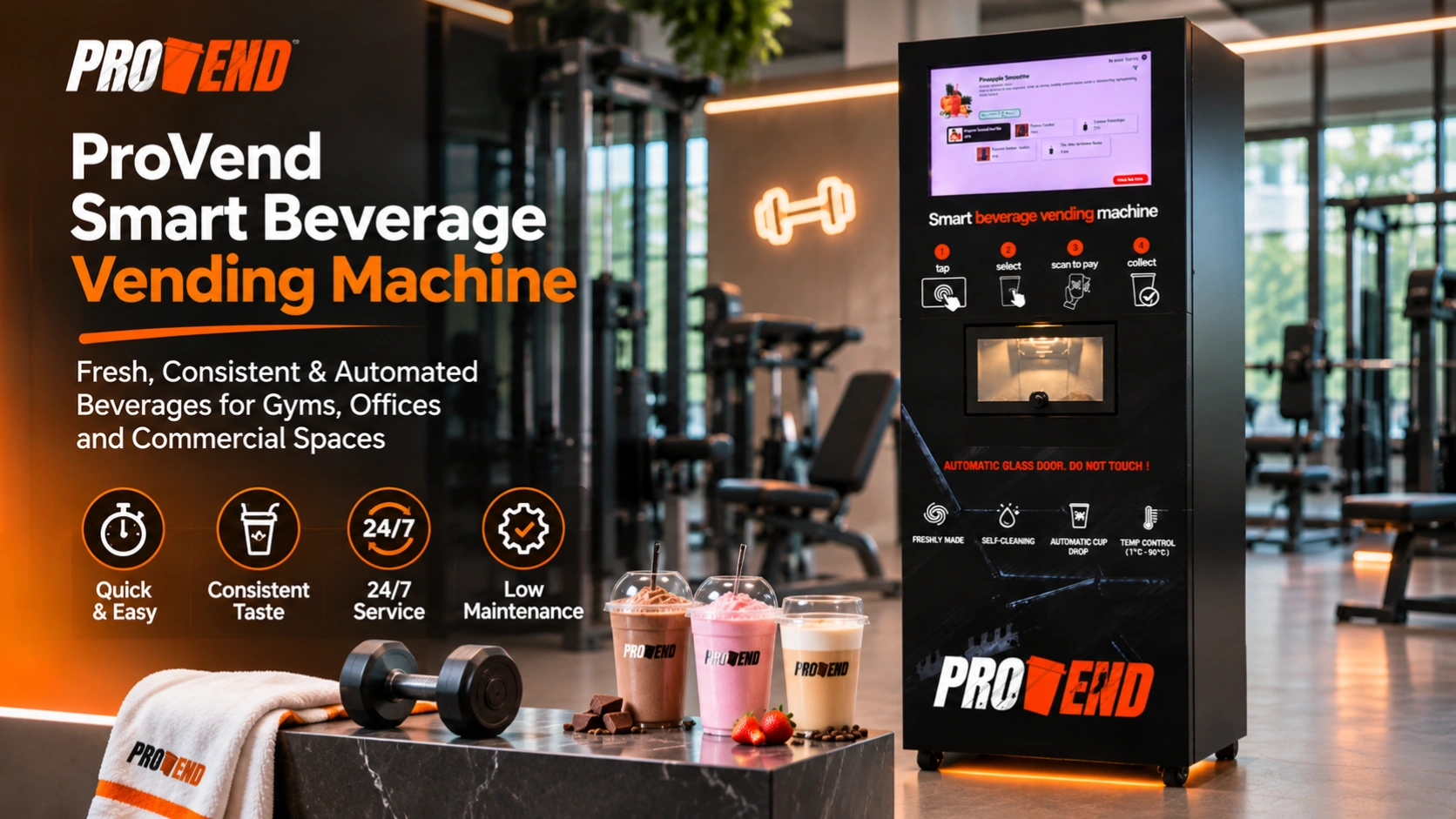
ProVend smart beverage vending machine offering automated protein shakes and other compatible drinks for gyms, offices, and commercial spaces.Image details
Promotional illustration of a ProVend smart beverage vending machine installed in a modern fitness center. The image features ProVend branding, a touchscreen beverage machine, and protein shake cups in different flavors. It highlights automated beverage preparation, convenient self-service, and the potential benefits of smart vending solutions for gyms, offices, and commercial facilities. The image supports ProVend's blog comparing beverage vending machines with hiring dedicated beverage preparation staff.
How to Decide Before Investing
Before buying or leasing a machine, estimate your likely daily beverage sales.
Next, calculate your current or proposed staffing expenses.
Then, compare those costs with the machine's total monthly ownership or lease allocation, consumables, servicing, and maintenance requirements.
Finally, consider the customer experience.
Will people prefer self-service? Is the location accessible? Can the machine serve the beverages customers actually want?
If possible, test demand before committing to a larger rollout.
A thoughtful comparison is much more useful than assuming that automation automatically guarantees higher profits.
Frequently Asked Questions
Is a beverage vending machine cheaper than hiring staff?
It can be, especially for repetitive drink preparation and extended operating hours. However, the result depends on equipment costs, staffing expenses, sales volume, and maintenance.
Can a vending machine replace a beverage counter employee?
A machine can automate supported drink preparation and payment workflows. However, it cannot replace every task performed by an employee, including customer assistance, replenishment, cleaning, and servicing.
How many drinks must a vending machine sell to be profitable?
There is no universal number. Profitability depends on contribution margin per drink, fixed costs, machine availability, and customer demand.
Can automated beverage machines operate 24/7?
Machines designed for unattended service can operate beyond staffed hours, provided they have the required utilities, consumables, maintenance, and operational safeguards.
Can ProVend machines prepare hot and cold beverages?
ProVend beverage vending configurations are designed to support compatible hot and cold premix-based drinks. Confirm the exact beverage menu, heating and cooling capabilities, and technical configuration before purchasing.
Is buying or leasing a beverage vending machine better?
Buying may suit businesses planning long-term use, while leasing can spread equipment costs over time. Compare total contract costs, servicing terms, ownership conditions, and expected beverage sales before deciding.
Final Verdict: Should You Hire Staff or Choose Automation?
The beverage vending machine vs hiring staff decision isn't really about choosing technology over people.
It's about deciding which tasks need human attention and which can be handled efficiently through automation.
For businesses offering highly customized drinks and personal service, trained employees remain valuable.
However, for gyms, offices, and commercial spaces serving repeatable beverage menus, an automated machine may offer a practical alternative to a dedicated preparation counter.
The best investment is the one that fits your customers, your budget, and the way your business operates.
Explore Automated Beverage Vending With ProVend
Thinking about introducing protein shakes, coffee, or hydration drinks without running a full-time beverage counter?