Beverage Vending Machine ROI: Can It Pay for Itself?
Calculate beverage vending machine ROI with realistic examples of drink sales, operating costs, break-even points and payback periods in India.
Explore beverage vending machine ROI with ProVend. Understand investment costs, monthly revenue, break-even calculations and potential payback periods before investing.Image details
A ProVend blog hero image illustrating the financial considerations of investing in an automated beverage vending machine. Featuring the original ProVend-branded machine in a modern gym setting, the image highlights investment and running costs, monthly revenue, break-even calculations and payback periods. Designed for gym owners, entrepreneurs and commercial facility managers researching beverage vending machine ROI in India. The visual introduces a practical guide to evaluating profitability without promising guaranteed returns.
Explore this article
12 sections
Beverage Vending Machine ROI: Can It Pay for Itself?
Can a beverage vending machine pay for itself? For gym owners, office managers, and entrepreneurs, understanding beverage vending machine ROI is essential before investing in automated beverage solutions.
Imagine turning an unused corner of your gym into a self-service beverage station that serves protein shakes, coffee, and other drinks without requiring a dedicated counter employee.
But how much revenue could it generate? What does each drink cost? And how long might it take to recover your investment?
Let's explore the numbers using a practical, illustrative example.
What Is Beverage Vending Machine ROI?
Return on investment (ROI) measures how much financial return a business generates compared with its initial investment.
For a beverage vending machine, the calculation depends on several factors:
Number of drinks sold daily
Average selling price per drink
Ingredient and packaging costs
Additional operating expenses
Initial machine investment
Importantly, revenue is not the same as profit.
To understand the potential, we'll first calculate beverage sales revenue and contribution after variable costs. Then we'll explain how additional operating expenses affect actual profitability and payback.
How Much Revenue Can a Beverage Vending Machine Generate?
Let's assume a ProVend beverage vending machine is installed inside an existing gym.
For this example, we'll use the following assumptions:
Parameter
Illustrative value
Average drinks sold daily
30
Average selling price per drink
₹90
Average variable cost per drink
₹35
Operating days per month
30
Initial machine investment
₹2,50,000
These figures are hypothetical and are not actual ProVend sales results or a machine price quotation.
Step 1: Calculate Monthly Revenue
Monthly revenue = Daily drinks sold × Average selling price × Operating days
30 × ₹90 × 30 = ₹81,000
The machine generates an illustrative ₹81,000 in monthly beverage sales revenue.
However, this is total sales revenue, not earnings.
Understanding Beverage Vending Machine Costs
Every drink sold has a cost associated with preparing and serving it.
These are called variable costs because they generally increase as more drinks are sold.
For our example, the assumed average variable cost is ₹35 per drink, covering items such as beverage premix, disposable cups, and applicable transaction charges.
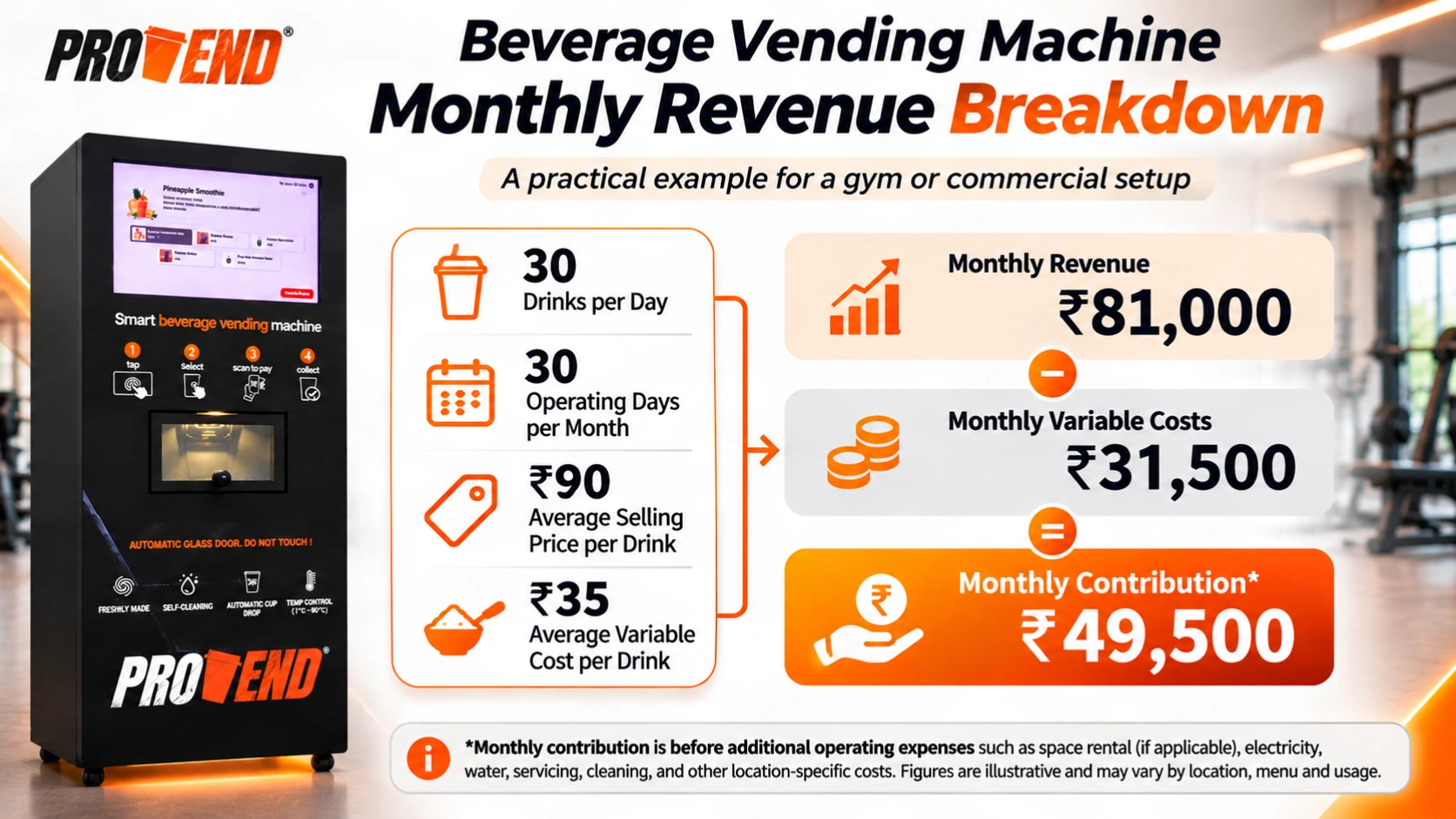
A ProVend beverage vending machine infographic explaining an illustrative monthly revenue calculation for gym owners and commercial businesses. Featuring the original ProVend machine and logo, the image shows 30 drinks sold daily at an average price of ₹90, with a ₹35 variable cost per drink. The example generates ₹81,000 monthly revenue, ₹31,500 variable costs and ₹49,500 monthly contribution before additional expenses such as electricity, water, servicing, cleaning and applicable space rental.
This means the machine generates an illustrative ₹49,500 monthly contribution* before additional operating expenses.
Monthly financial breakdown
Amount
Beverage sales revenue
₹81,000
Variable beverage costs
₹31,500
Monthly contribution*
₹49,500
Monthly contribution is not net profit. Space rental, incremental electricity and water, servicing, cleaning, and other additional operating expenses are excluded.
Why Existing Gym Owners May Have Lower Operating Overheads
One advantage of installing a beverage vending machine inside an existing gym or commercial facility is the potential to use resources already available.
For example, a gym owner may already have:
Available floor space near the reception or workout area
An existing electricity and water connection
Staff who can help with routine cleaning and replenishment
An established customer base
Therefore, installing a beverage vending machine may not require renting additional space or hiring a dedicated employee.
However, this does not mean the machine operates without expenses. Additional electricity consumption, water usage, maintenance, cleaning time, and other costs should still be considered.
For independent vending operators placing machines in third-party locations, rent or revenue-sharing arrangements may also apply.
The key is to calculate the additional costs that apply to your particular business—not assume every installation has the same monthly overhead.
Beverage Vending Machine ROI: How Long Could Payback Take?
Now let's examine the potential investment recovery period.
For this example, assume an initial machine investment of ₹2,50,000.
We have already calculated an illustrative monthly contribution of ₹49,500 before additional operating expenses.
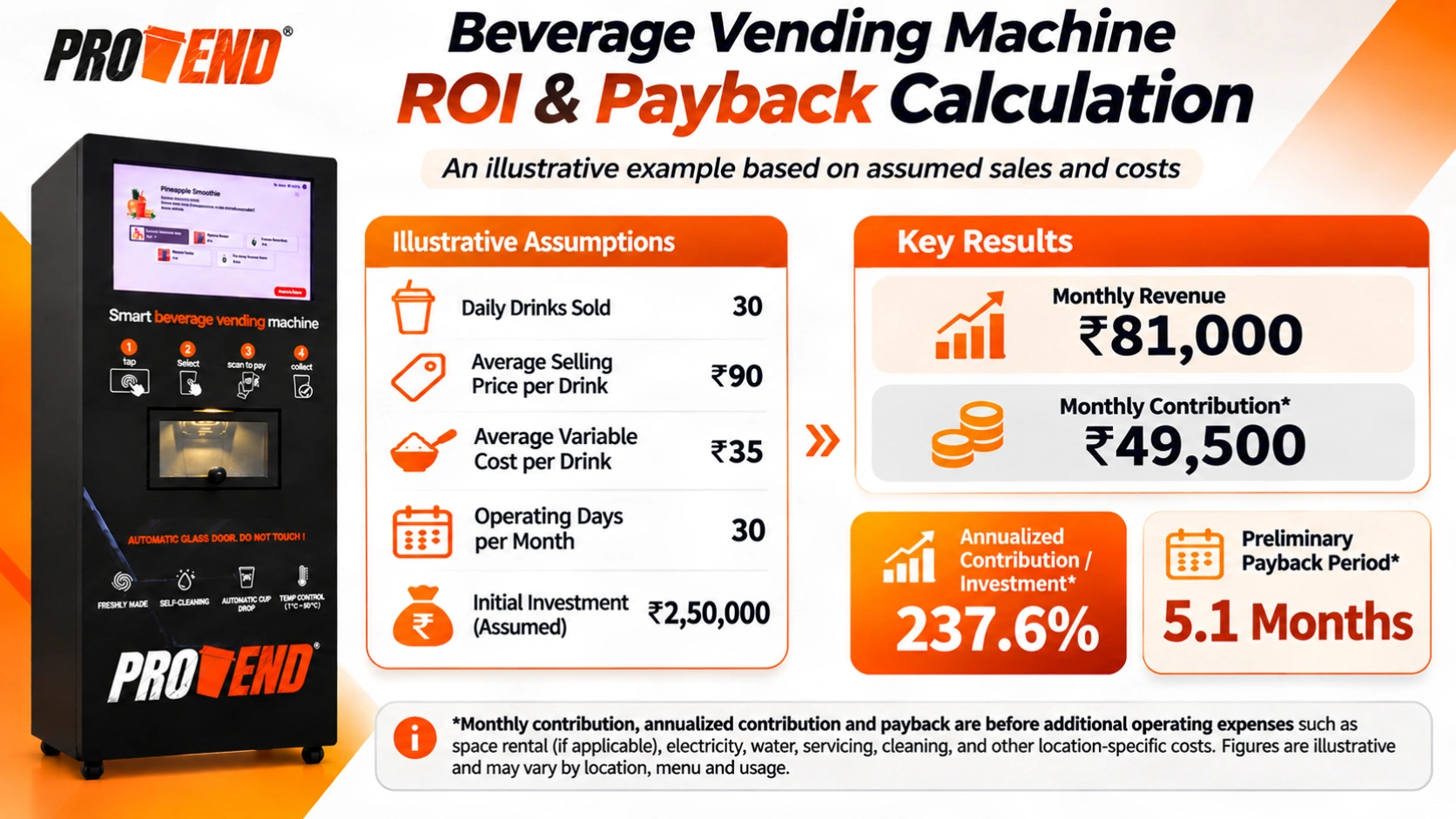
Illustrative beverage vending machine ROI calculation showing ₹81,000 monthly revenue, ₹49,500 contribution before additional operating expenses, and a preliminary payback period of 5.1 months.Image details
ProVend beverage vending machine ROI and payback infographic featuring the original ProVend machine and logo. The illustration uses an assumed initial investment of ₹2,50,000, daily sales of 30 drinks, an average selling price of ₹90, and an average variable cost of ₹35 per drink. It demonstrates ₹81,000 in monthly revenue, ₹49,500 monthly contribution before additional operating expenses, a 237.6% annualized contribution-to-investment ratio, and a preliminary payback period of approximately 5.1 months. These are hypothetical financial estimates, not guaranteed returns or net ROI. Additional expenses such as electricity, water, cleaning, servicing, and applicable space rental are excluded.
This is a simplified, contribution-based estimate—not a complete investment payback forecast.
Actual payback will take longer if additional operating expenses apply. Sales fluctuations, downtime, taxes, financing, and other costs can also affect recovery.
Step 5: Calculate Annualised Contribution Relative to Investment
This percentage compares an annualised contribution estimate with the assumed initial investment. It is not net ROI, because additional operating expenses have not been deducted.
These figures help illustrate the machine's potential earning capacity, but they should not be interpreted as guaranteed financial returns.
How Daily Beverage Sales Affect Earnings
Sales volume can make a substantial difference to a vending machine's financial performance.
Using the same ₹90 average selling price and ₹35 average variable cost per drink, here's how monthly contribution changes at different sales levels.
Drinks sold daily
Monthly revenue
Monthly contribution*
10
₹27,000
₹16,500
20
₹54,000
₹33,000
30
₹81,000
₹49,500
40
₹1,08,000
₹66,000
50
₹1,35,000
₹82,500
Illustrative figures based on 30 operating days per month. Monthly contribution excludes additional operating expenses and is not net profit.
The example highlights why location, customer demand, pricing, and beverage selection matter.
Even small changes in daily sales can significantly affect the contribution available to cover operating costs and recover the investment.
What Is the Break-Even Point for a Beverage Vending Machine?
Break-even occurs when the revenue generated covers the relevant costs.
In our example:
Average selling price per drink: ₹90
Average variable cost per drink: ₹35
Contribution per drink: ₹55
Every drink sold contributes ₹55 toward covering additional operating expenses and recovering the initial investment.
However, a complete operating break-even point cannot be calculated without knowing those additional expenses.
For example, if a particular installation incurs ₹5,500 in monthly fixed operating costs, it would need to sell:
₹5,500 ÷ ₹55 = 100 drinks per month
That's approximately four drinks per day over 30 days to cover those assumed fixed operating costs.
Recovering the initial machine investment is a separate financial objective.
Five Ways to Improve Beverage Vending Machine ROI
1. Choose a High-Demand Location
Gyms, corporate offices, fitness studios, and other facilities with consistent beverage demand may offer promising installation opportunities.
A good location should combine visibility, convenience, and suitable customer traffic.
A gym may prioritise protein shakes and hydration beverages, while an office might experience stronger demand for coffee and tea.
Matching the beverage menu to customer preferences can help improve sales.
3. Set Practical Selling Prices
Your selling price should reflect ingredient costs, customer expectations, and local competition.
A healthy contribution margin is important, but pricing should remain attractive enough to encourage repeat purchases.
4. Keep the Machine Clean and Well-Stocked
Regular replenishment, cleaning, and preventive maintenance support customer experience and reduce avoidable interruptions.
Food safety and hygiene are also important when operating an automated beverage vending machine. Business owners should follow applicable food safety requirements and consult the Food Safety and Standards Authority of India (FSSAI) for official guidance on food business compliance in India.
5. Track Sales and Expenses
Monitor daily drink sales, popular beverages, ingredient consumption, wastage, and additional operating costs.
This helps you understand actual profitability instead of relying only on projected revenue.
How ProVend Fits Into Your Beverage Business
ProVend offers automated beverage vending solutions designed for environments such as gyms, offices, and other commercial spaces.
Depending on the machine configuration, ProVend beverage vending machines can prepare premix-based drinks such as protein shakes, coffee, tea, and other beverages.
For existing business owners, a self-service beverage station can provide an additional sales opportunity without establishing a traditional staffed beverage counter.
Meanwhile, entrepreneurs can evaluate suitable third-party locations based on footfall, customer demand, and installation costs.
The right financial outcome depends on the machine configuration, selling prices, operating conditions, and actual beverage sales.
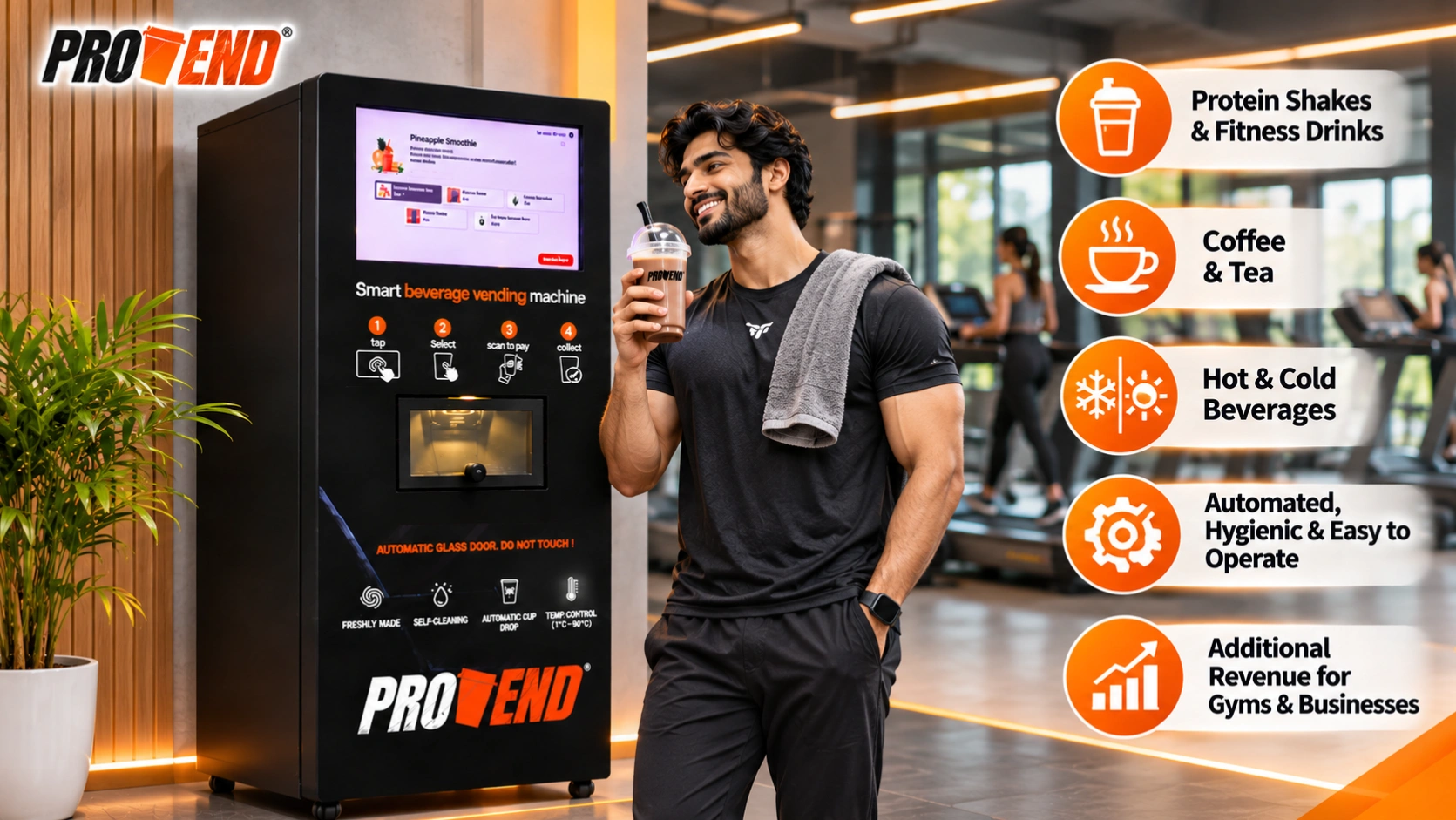
ProVend smart beverage vending machines help gyms offer protein shakes, coffee, tea and other drinks while creating an additional revenue opportunity.Image details
A promotional image featuring a black ProVend smart beverage vending machine installed inside a modern fitness gym. A gym member enjoys a protein shake beside the machine, while visual highlights showcase protein shakes, fitness drinks, coffee, tea, hot and cold beverages, automated preparation and additional revenue opportunities for gym owners. The image illustrates how ProVend beverage vending solutions can help gyms and commercial businesses offer convenient self-service drinks without setting up a traditional beverage counter.
Frequently Asked Questions
1. Is a beverage vending machine profitable in India?
A beverage vending machine can be profitable when sales revenue exceeds ingredient costs and all applicable operating expenses. Profitability depends on location, demand, pricing, machine utilisation, and ongoing costs.
2. How much can a beverage vending machine earn per month?
In our illustrative example, selling 30 drinks daily at ₹90 generates ₹81,000 in monthly revenue and ₹49,500 in monthly contribution before additional operating expenses. These figures are assumptions, not guaranteed earnings.
3. Do gym owners need to pay additional rent for a vending machine?
Not necessarily. Gym owners with suitable available space may be able to install a machine without paying additional rent. Other incremental operating expenses may still apply.
4. How long does it take to recover the investment?
The recovery period depends on actual cash flow after all operating expenses. Our illustrative contribution-based calculation produces a preliminary estimate of 5.1 months, but real payback may be longer.
5. Can a beverage vending machine operate without dedicated staff?
Automated beverage vending machines can reduce the need for a dedicated beverage counter employee. However, cleaning, replenishment, maintenance, and customer support still require attention.
6. What affects beverage vending machine ROI the most?
The main factors include daily sales volume, average selling price, beverage cost per serving, installation location, operating expenses, downtime, and initial investment.
Final Thoughts: Is a Beverage Vending Machine Worth the Investment?
A beverage vending machine can create an additional revenue opportunity for gyms, offices, and commercial facilities.
For businesses with existing space and staff, the additional operating overhead may be lower than for an independent operator renting a location.
Our example demonstrates how ₹81,000 in monthly revenue could generate ₹49,500 in monthly contribution before additional operating expenses under the stated assumptions.
However, actual profitability and investment recovery should always be calculated using your own sales projections and complete cost structure.
Explore ProVend Beverage Vending Machines
Looking to introduce automated protein shakes, coffee, tea, or other beverages at your location?
Financial disclaimer: All calculations in this article are hypothetical examples for educational purposes. The assumed ₹2,50,000 investment is not a verified ProVend quotation. Monthly contribution excludes space rental, electricity, water, servicing, cleaning, and other additional operating expenses. Existing businesses may already cover some resources, but incremental costs should still be considered. Annualized contribution-to-investment ratios and preliminary payback calculations are not equivalent to net ROI or guaranteed investment returns. Actual performance will vary.