Use this beverage vending machine buying checklist to compare 12 essential factors, including drink options, pricing, maintenance, hygiene and support.
Planning to buy a beverage vending machine? Explore 12 essential questions about beverage options, hot and cold drinks, operating costs, maintenance, and supplier support with ProVend.Image details
A ProVend branded hero image featuring a smart beverage vending machine in a modern gym environment alongside a comprehensive buyer’s checklist. The visual highlights beverage variety, hot and cold drink options, total cost of ownership, maintenance and cleaning, after-sales support, and expected demand. Designed for gym owners, corporate facility managers, entrepreneurs, and commercial buyers looking to make informed beverage vending machine purchasing decisions in India.
Explore this article
18 sections
12 Questions to Ask Before Buying a Beverage Vending Machine
A beverage vending machine buying checklist can help you choose the right machine, avoid unnecessary expenses, and make a more informed business investment.
However, with several machine configurations and suppliers available, knowing what to look for can be challenging.
Whether you own a gym, manage a corporate office, or plan to start a vending business, asking the right questions is essential.
Therefore, we've created this practical guide covering 12 important questions about beverage options, operating costs, maintenance, payment methods, and supplier reliability.
1. What Types of Beverages Can the Machine Serve?
First, consider what your customers actually want to drink.
For example, a gym may benefit from protein shakes and hydration beverages, while an office might prioritise coffee and tea.
Depending on the machine's configuration, beverage options may include:
Protein shakes
Coffee and tea
Hot chocolate
Electrolyte drinks
Other compatible premix-based beverages
Buying tip: Ask the supplier for a demonstration using the beverages you intend to sell. Not every machine supports every recipe or ingredient.
2. Does It Support Both Hot and Cold Drinks?
A machine that supports hot and cold beverages can offer greater menu flexibility.
For instance, office employees may prefer hot coffee in the morning, while gym members may choose chilled protein shakes after workouts.
However, not all vending machines have integrated heating and cooling systems.
Therefore, confirm whether both temperature options are available in the model you're considering.
Also, ask about temperature settings, preparation times, and the number of drinks the machine can serve consecutively.
3. How Many Beverage Options Can It Offer?
The number of beverages available depends on the machine's configuration, canisters, ingredient compatibility, and recipe settings.
Some machines are designed for a limited menu. Others can accommodate several premix options.
Before purchasing, ask:
How many ingredient canisters are included?
How many beverages can customers select?
Can recipes and serving sizes be adjusted?
Can you change the menu later?
Remember: More beverage options aren't automatically better. A focused menu that matches customer demand may be easier to manage.
4. What Is the Total Cost of Ownership?
The machine's purchase price is only one part of the investment.
In addition, you should consider the costs involved in operating it.
These may include:
Beverage premixes and cups
Electricity and water
Cleaning supplies
Servicing and replacement parts
Payment processing charges
Delivery and installation
Applicable space rental
For existing gym or office owners, some facilities may already be available. Nevertheless, any additional operating expenses should still be considered.
Therefore, your beverage vending machine buying checklist should include both the initial investment and ongoing operating expenses.
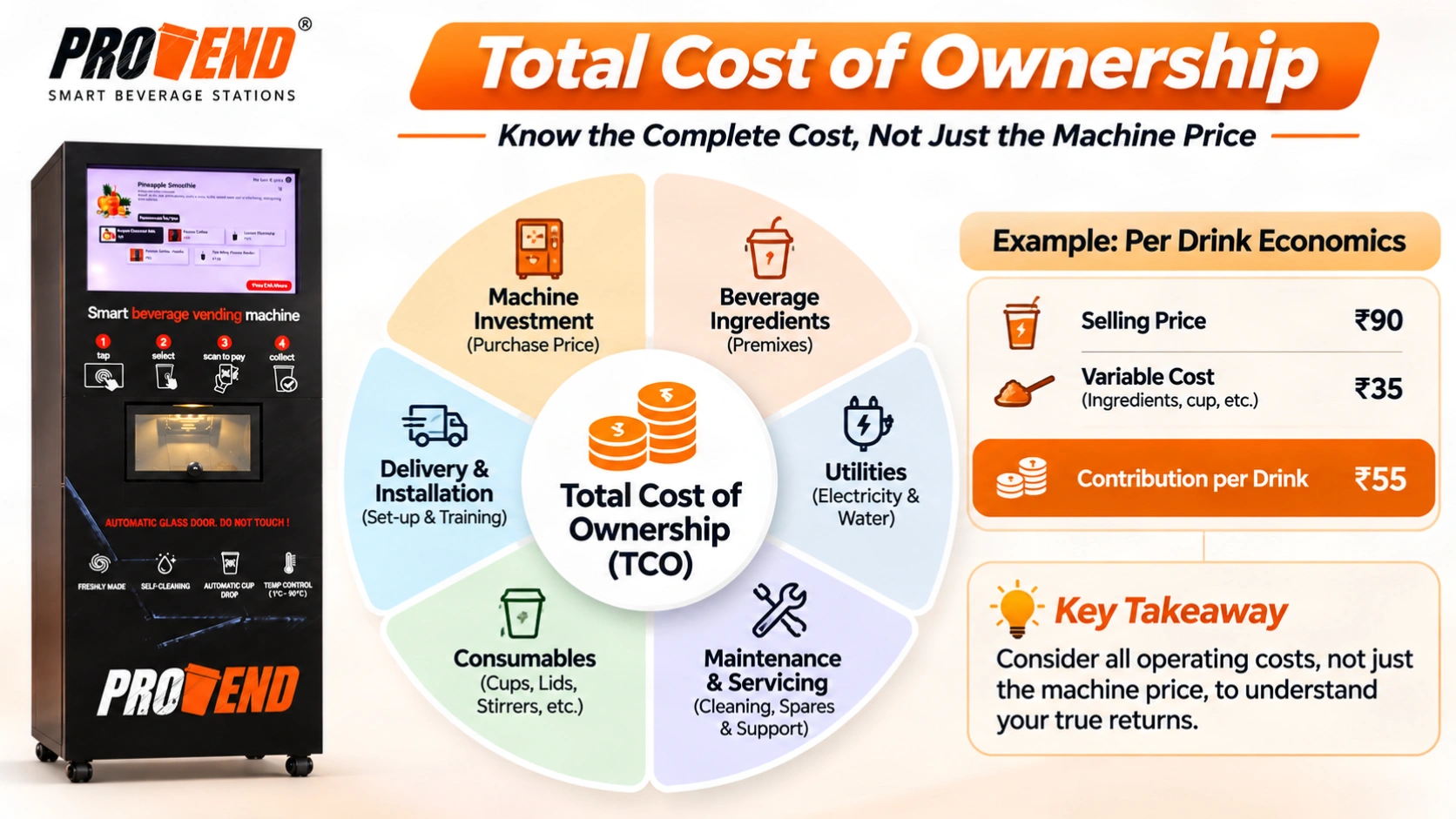
Understand the total cost of owning a beverage vending machine, including machine investment, ingredients, utilities, consumables, installation and maintenance. The illustrative example shows a ₹55 contribution per drink before additional operating expenses.Image details
An educational ProVend infographic explaining the total cost of ownership (TCO) of a smart beverage vending machine. It highlights six essential cost categories: machine investment, beverage ingredients, utilities, consumables, maintenance and servicing, and delivery and installation. The infographic also presents an illustrative financial example with a ₹90 selling price, ₹35 variable cost and ₹55 contribution per drink before additional operating expenses. Designed to help gym owners, corporate facility managers, entrepreneurs and commercial buyers evaluate vending machine investments in India.
Example: Understanding Beverage Costs
Suppose a drink sells for ₹90 and its variable cost is ₹35.
The contribution per drink would be:
₹90 − ₹35 = ₹55
However, this ₹55 is not net profit. It must also cover applicable operating expenses and contribute toward recovering the machine investment.
A complicated vending machine can discourage first-time customers.
Therefore, look for a clear and simple purchasing experience.
Ideally, customers should be able to:
Select a beverage.
Choose available options.
Complete payment.
Wait for preparation.
Collect their drink.
For gyms and offices, an intuitive touchscreen interface can be especially helpful because customers may use the machine without assistance.
Buying tip: Test the complete ordering process yourself before making a decision.
6. Which Payment Methods Are Supported?
Digital payments are an important consideration for self-service vending machines.
For businesses in India, customers may expect convenient payment options such as UPI.
However, payment capabilities can vary by machine and integration.
Ask your supplier whether the proposed model supports your preferred payment methods.
Additionally, confirm how failed transactions, refunds, payment confirmations, and connectivity problems are handled.
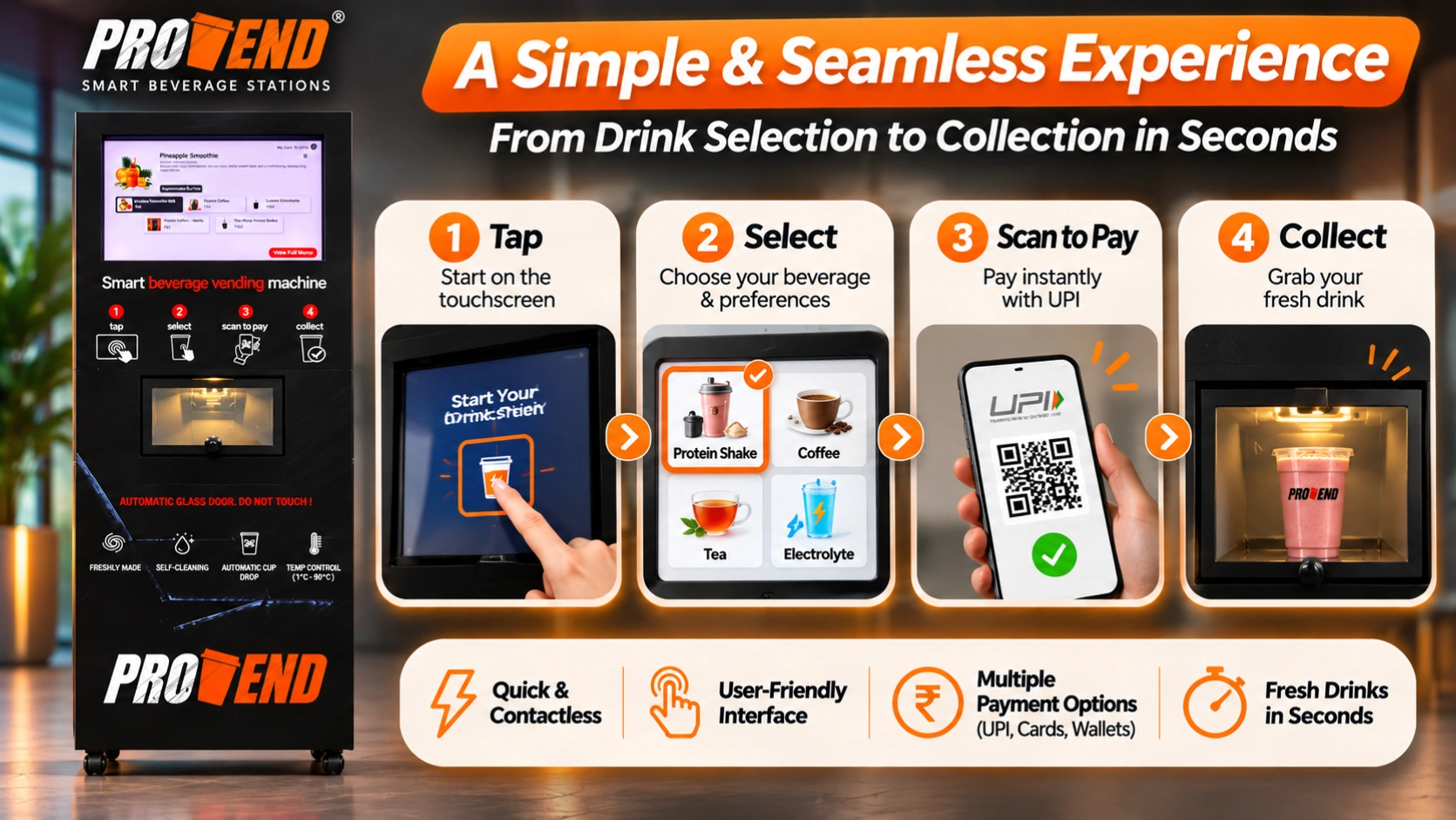
Experience a simple four-step beverage purchasing journey with ProVend: tap, select, scan to pay and collect your freshly prepared drink.Image details
A ProVend branded infographic illustrating the customer experience of an automated smart beverage vending machine. The visual demonstrates four essential steps, including touchscreen interaction, beverage selection, UPI QR code payment and fresh drink collection. It features protein shakes, coffee, tea and electrolyte beverages, highlighting the convenience of self-service beverage automation for gyms, corporate offices and commercial facilities in India. The infographic helps prospective buyers understand the importance of user-friendly interfaces and digital payment integration when choosing a beverage vending machine.
Machine downtime can affect customer satisfaction and potential sales.
Consequently, after-sales service should be an important part of your buying decision.
Ask about:
Warranty coverage
Availability of replacement parts
Technical support channels
Expected service response times
Installation and operator training
Don't rely only on verbal promises. Instead, request written warranty and service terms.
Furthermore, a comprehensive beverage vending machine buying checklist should include warranty coverage, spare parts availability, and technical support.
9. How Much Space Does the Machine Need?
Before selecting a machine, measure the intended installation area.
Apart from the machine's physical dimensions, consider the space needed for customer access, ventilation, cleaning, and servicing.
For example, a gym may have a suitable corner near its reception area.
However, a machine that obstructs walkways or emergency exits would be unsuitable.
Also, confirm the machine's electrical requirements, water arrangements, and installation conditions.
A machine suitable for a small office may not be ideal for a busy commercial gym.
Therefore, ask about practical serving capacity rather than relying only on promotional specifications.
Important questions include:
How long does one drink take to prepare?
How many drinks can be prepared consecutively?
How frequently do ingredients need refilling?
What happens when a premix runs out?
Can the machine handle peak-hour demand?
For example, if several gym members finish their workouts simultaneously, preparation speed becomes particularly important.
Buying tip: Request a live demonstration with consecutive drink orders.
11. Can You Monitor Sales and Inventory?
For business owners, understanding beverage sales can help improve purchasing and replenishment decisions.
Some smart vending machines offer sales reports, remote monitoring, or inventory-related features.
However, these capabilities are model-dependent.
Ask whether the machine supports:
Daily and monthly sales reporting
Beverage-wise sales information
Payment reconciliation
Ingredient or stock alerts
Machine status notifications
If these features are important to your business, request a demonstration of the actual software.
12. Is the Supplier Suitable for Your Long-Term Business?
Finally, evaluate the company behind the machine.
A beverage vending machine is a long-term equipment purchase. Therefore, supplier reliability matters beyond the initial sale.
Consider asking:
Does the supplier provide installation assistance?
Is operator training included?
Are compatible premixes readily available?
Can replacement parts be purchased?
What happens after the warranty expires?
Can the supplier support future expansion?
Additionally, ask for clear documentation covering technical specifications, commercial terms, and service responsibilities.
A reliable supplier should help you understand both the machine's benefits and its limitations.
Beverage Vending Machine Buying Checklist: Common Mistakes to Avoid
Even experienced business owners can overlook important details.
Here are four mistakes worth avoiding:
Choosing only by price: A lower purchase price may not provide the features or support your business needs.
Ignoring customer demand: A large beverage menu is not useful if customers rarely purchase those drinks.
Underestimating maintenance: Every beverage machine requires regular attention, even when preparation is automated.
Assuming guaranteed profitability: Actual returns depend on sales volume, drink pricing, ingredient costs, and operating expenses.
Instead, compare machines based on their suitability for your location and business model.
How ProVend Fits Your Beverage Vending Machine Buying Checklist
At ProVend, we focus on smart beverage vending solutions for gyms, offices, and commercial environments.
Our premix-based beverage machines are designed to automate drink preparation and provide convenient self-service access to beverages such as protein shakes, coffee, and tea.
Depending on the selected configuration, hot and cold beverage options can help businesses serve different customer preferences.
For gym owners, this may create an opportunity to offer post-workout beverages using existing commercial space.
Meanwhile, offices and other facilities can explore automated beverage service without setting up a traditional staffed beverage counter.
However, the right configuration depends on your location, expected demand, preferred menu, and operational requirements.
Final Beverage Vending Machine Buying Checklist Before Purchase
Before finalizing your purchase, make sure you can answer these questions:
Does the machine support my preferred beverages?
Are hot and cold options available if needed?
Is the beverage capacity suitable for my location?
Have I calculated the full cost of ownership?
Is the ordering and payment process simple?
Are cleaning procedures clearly documented?
Is warranty and technical support available?
Will the machine fit my installation area?
Can it handle expected peak-hour demand?
Are sales and inventory features available if required?
Can I obtain compatible ingredients and spare parts?
Have I reviewed the supplier's written commercial terms?
Ultimately, the best machine isn't necessarily the one with the most features. It's the one that matches your customers, budget, and operational needs.
Frequently Asked Questions
1. What should I check before buying a beverage vending machine?
Check beverage compatibility, heating and cooling options, serving capacity, total operating costs, cleaning requirements, payment methods, warranty, and after-sales support.
2. Are beverage vending machines suitable for gyms?
Yes. A suitable beverage vending machine can help gyms offer protein shakes and other drinks conveniently. However, the menu and machine capacity should match member demand.
3. Can one machine serve both coffee and protein shakes?
Some multi-beverage vending machines can prepare both coffee and protein shakes using compatible premixes and appropriate dispensing configurations. Confirm the exact capabilities with the supplier.
4. Do beverage vending machines require dedicated staff?
Not necessarily. Automated machines can reduce the need for dedicated beverage preparation staff. However, cleaning, refilling, maintenance, and customer support still require attention.
5. How do I calculate beverage vending machine profitability?
Start with monthly beverage revenue, subtract variable beverage costs, and then deduct all applicable operating expenses. To evaluate investment recovery, compare actual cash flow with the total initial investment.
6. Where can I install a commercial beverage vending machine?
Potential locations include gyms, corporate offices, hotels, colleges, hospitals, and other commercial facilities, subject to suitable infrastructure, permissions, customer demand, and applicable requirements.
Ready to Explore a ProVend Beverage Vending Machine?
By following this beverage vending machine buying checklist, you can compare suppliers more effectively and select a machine that suits your business requirements.
Choosing the right vending machine starts with asking the right questions.
Whether you're upgrading your gym's beverage service, improving office amenities, or exploring a new vending business, ProVend can help you evaluate a suitable automated beverage solution.
Visit www.theprovend.com to explore ProVend and discuss your requirements.
Disclaimer: Machine features, compatibility, capacity, and commercial terms depend on the selected configuration. Financial examples are illustrative and do not represent guaranteed returns.